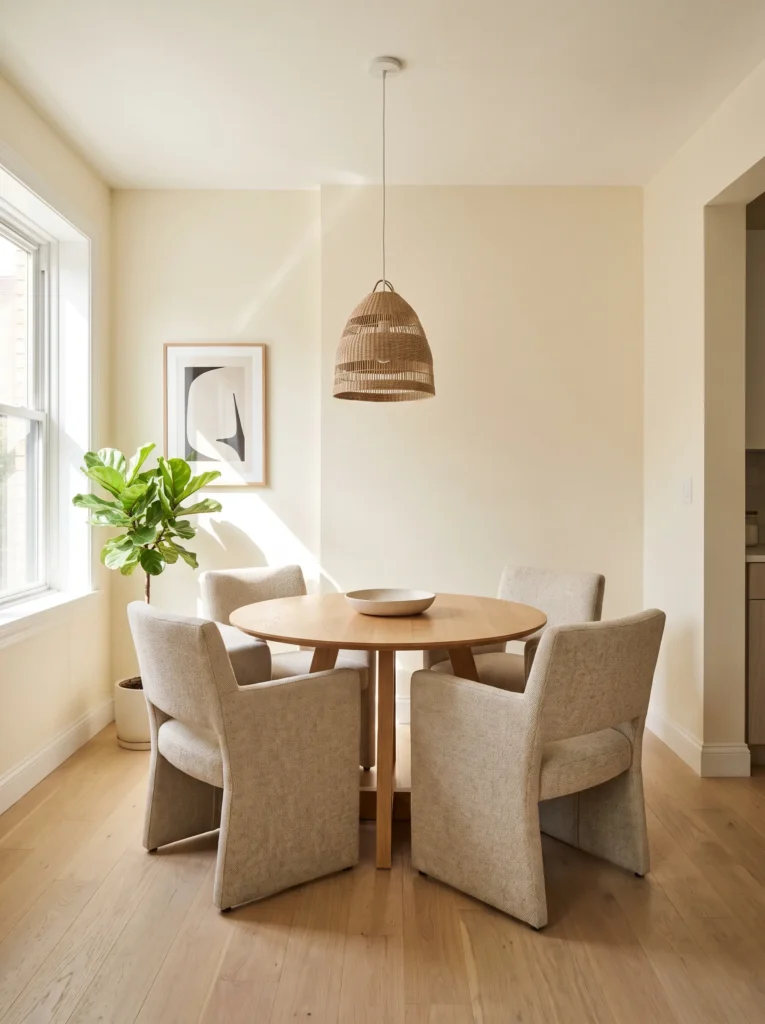
Dining table proportioned to leave comfortable walking space around the room.

How to Choose a Dining Table That Fits Your Space and Lifestyle

A dining table can look perfectly proportioned in a showroom and still feel completely wrong once it arrives in your home.

Sometimes the problem isn’t the table itself. It’s the relationship between the table, the room, the chairs, and the people using it.

A table that comfortably seats six may leave a small dining room feeling cramped. A beautiful round table might work wonderfully for conversation but become awkward if the room is long and narrow. And a compact four-person table may seem practical until you regularly have family or friends over for dinner.

The right dining table isn’t simply the one that fits the number of people you want to seat.

It needs to fit the room and the way you actually live in it.

Before choosing a shape, material, or finish, look at the space available, how people move through it, how many people normally sit down, and what you expect from the table on an ordinary day.

Start With the Room, Not the Table

The easiest mistake is to fall in love with a table before measuring the room.

Instead, start by looking at the area where the table will live.

Measure the usable floor space, but don’t stop at the empty rectangle between the walls. Consider everything that will remain in the room:

  • Dining chairs
  • Cabinets or sideboards
  • Doors
  • Windows
  • Walkways
  • Heating or cooling vents
  • Nearby kitchen counters
  • Other furniture

The table needs room around it because people don’t sit perfectly still.

Chairs need to be pulled out. Someone may need to walk behind a seated person. A cabinet door may need to open. Someone carrying a serving dish may need to pass through.

A table that technically fits can still make the room frustrating to use. Furniture measurements matter because the space around a piece is often just as important as the piece itself.

That’s why clearance should be considered before table dimensions.

Give People Enough Room to Move Around the Table

A dining table shouldn’t consume the entire circulation area.

As a general planning starting point, aim for roughly 36 inches of space between the table edge and nearby walls or furniture where people need to walk or pull out chairs. Around 42–48 inches can feel more comfortable in areas with heavier traffic or where people regularly move behind seated diners.

The exact amount depends on your layout.

A table in a dedicated dining room may need less flexibility than one positioned between the kitchen and living room.

Think about what happens during a normal meal.

Someone gets up.

Another person walks behind them.

A child leaves the table.

Someone brings food from the kitchen.

If those movements require everyone else to squeeze sideways, the table is probably too large for the space.

Choose the Table Shape That Works With the Room

Round dining table creating comfortable circulation in a small dining area.

Shape isn’t just a style decision.

It can determine how efficiently the table uses the available floor space.

Rectangular Tables

Rectangular tables are usually the easiest choice for longer dining rooms and open spaces.

They provide a clear seating arrangement and can accommodate more people without requiring a large amount of additional width.

They’re particularly useful when you want to place the table along the visual length of a room.

But a very long rectangular table can overwhelm a narrow dining area.

Round Tables

Round tables can work beautifully in smaller dining spaces because they eliminate sharp corners and create a more relaxed visual flow.

They’re also excellent for conversation because everyone faces toward the center.

A round table becomes less practical as it gets very large, however. Reaching across the center can become inconvenient, and the table can occupy more floor area than its appearance initially suggests.

Square Tables

Square tables work best when the room itself has relatively balanced proportions.

They’re particularly useful for smaller households because everyone has a similar amount of space around the table.

But a large square table can quickly consume a lot of floor area.

Oval Tables

Oval tables combine some of the advantages of rectangular and round designs.

They offer a longer seating arrangement while softened ends make the table feel less visually rigid.

They’re particularly useful when you want the capacity of a rectangular table without introducing as many sharp corners into the room.

Let Your Everyday Household Determine the Seating

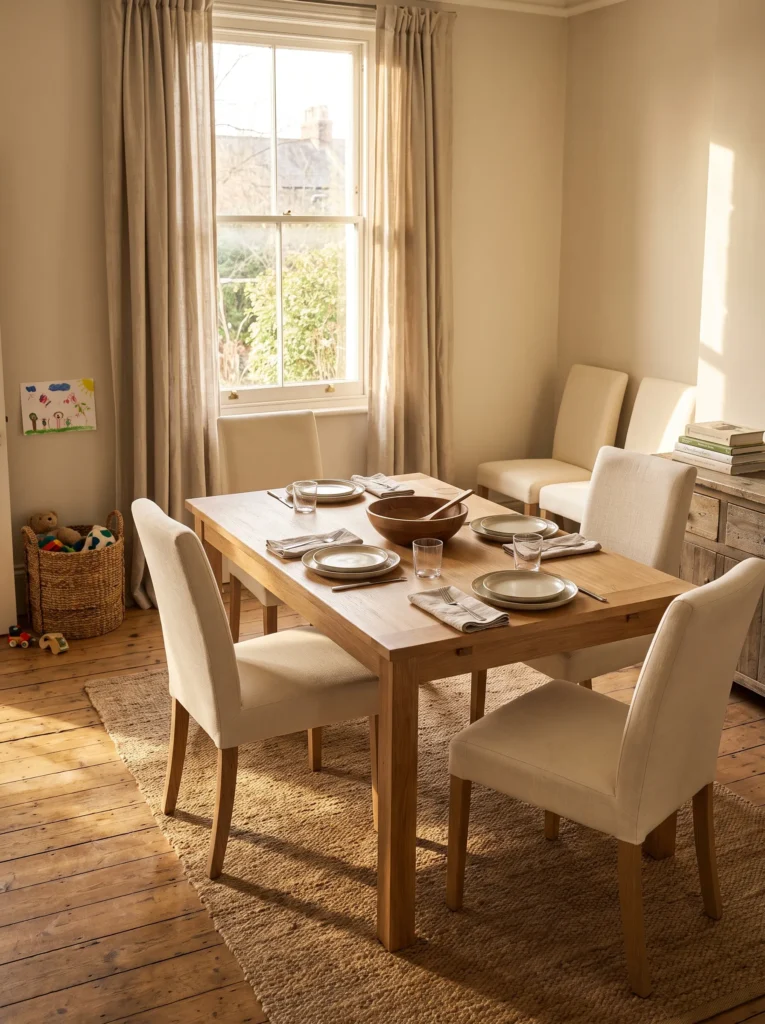
Dining table comfortably sized for everyday family meals and additional seating.

Don’t choose a table based only on the maximum number of people you could seat.

Think about how many people actually use it most days.

A family of four doesn’t necessarily need a table designed for eight.

If the larger table makes the room crowded every day just so you can accommodate occasional guests, you may be sacrificing everyday comfort for something that happens a few times a year.

On the other hand, if your dining table regularly doubles as a homework station, work area, craft table, or gathering spot, additional surface area may be worthwhile.

Ask yourself:

Who uses this table on a normal weekday?

Then ask:

What happens when guests come over?

Those two answers can point you toward a very different table.

Don’t Forget the Space Each Person Needs

The number of seats advertised by a furniture retailer doesn’t always tell the whole story.

Two tables may both be described as six-person tables but feel very different once six people are actually sitting around them.

As a general planning guideline, allow approximately 24 inches of table edge per person for comfortable everyday dining. Slightly less can work for casual or occasional seating, while more space can feel noticeably more comfortable.

This becomes especially important when comparing:

  • Armchairs and standard dining chairs
  • Wide upholstered chairs
  • Chairs with arms
  • Bench seating
  • Compact apartment-size chairs

The chairs themselves can change how many people you can realistically seat.

Consider the Chairs Before Finalizing the Table

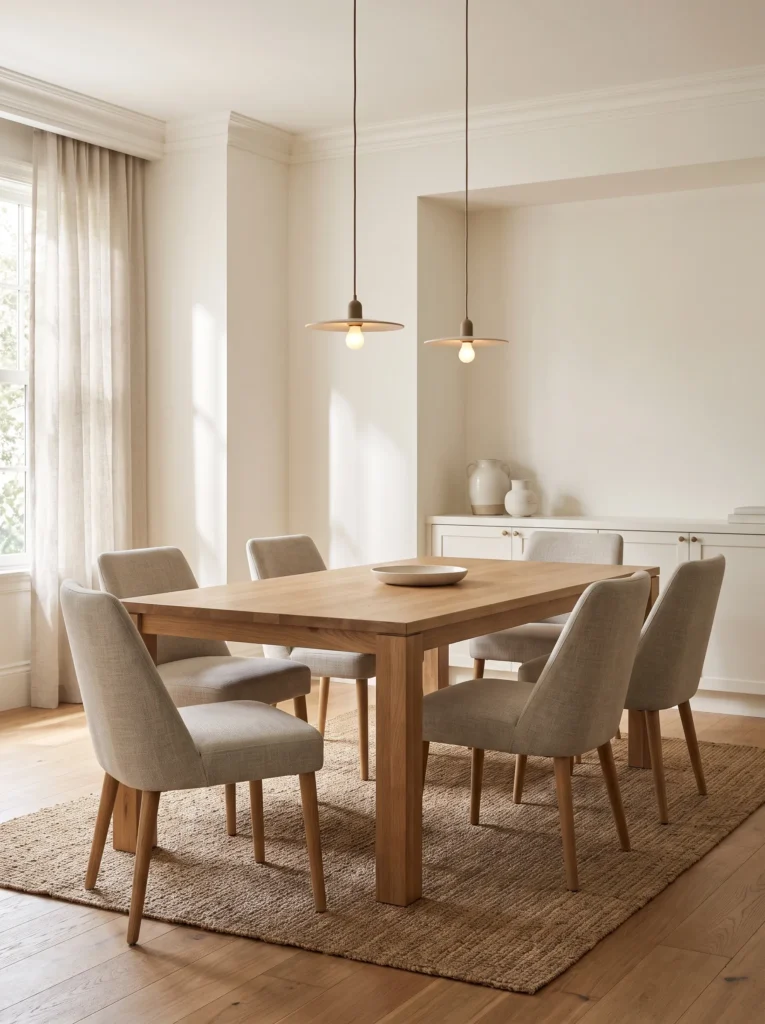
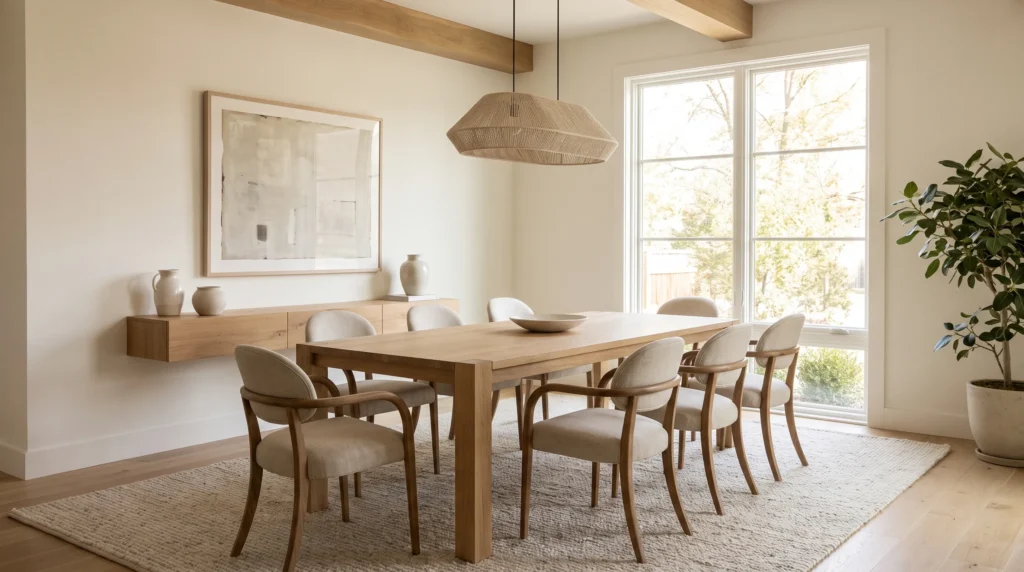
Dining table and chairs with comfortable proportions and practical legroom.

The table and chairs should be treated as one decision.

A table might have the perfect length, but if your chosen chairs are unusually wide, the arrangement can quickly become crowded.

Chair height matters too.

A standard dining table is generally around 28–30 inches high, but the relationship between the seat and tabletop is more important than the table height in isolation.

Make sure there’s comfortable legroom beneath the table and enough space for people to sit without their knees hitting the underside or nearby table supports.

This is one reason pedestal tables can be particularly useful in some layouts: they can provide more flexible legroom than tables with substantial corner legs.

Small Dining Room? Prioritize Movement

A small dining room doesn’t necessarily require the smallest possible table.

It requires a table that uses the available space intelligently.

This might mean choosing:

  • A round table instead of a square one
  • A narrower rectangular table
  • A pedestal base
  • A drop-leaf design
  • An extendable table
  • A bench on one side

The goal is to preserve the room’s circulation while still giving you enough usable dining space.

If the dining area connects directly to a kitchen or living room, this becomes even more important.

The table isn’t sitting in an isolated box.

It’s part of the home’s traffic pattern.

An Extendable Table Can Solve Two Different Problems

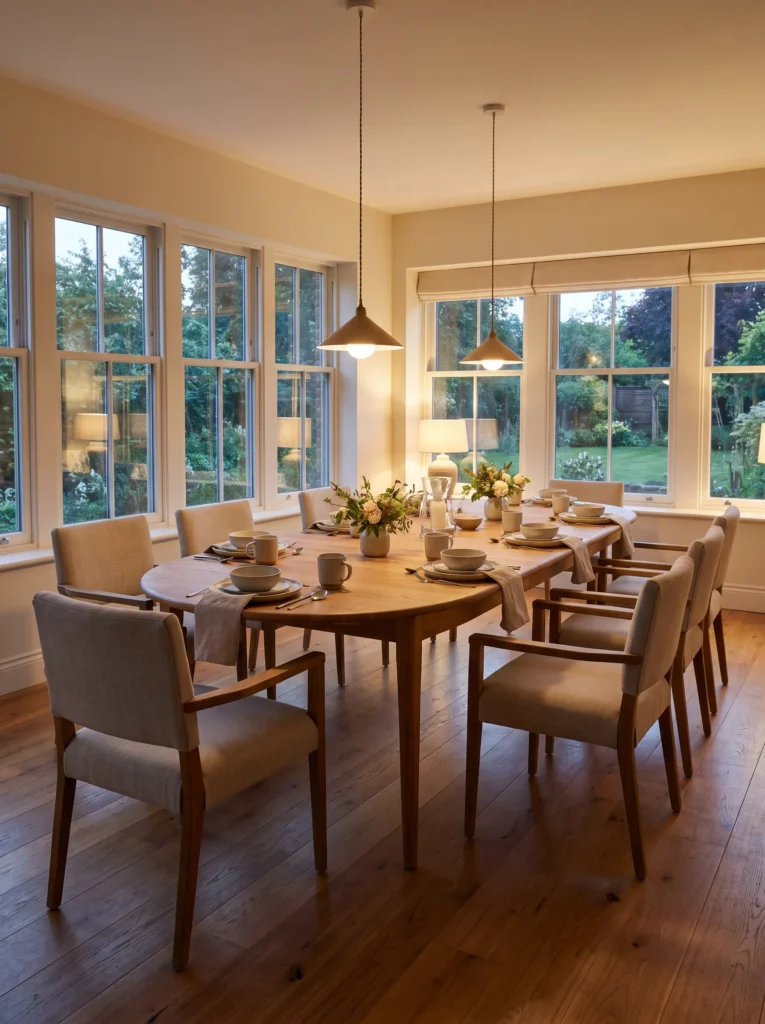
Extendable dining table providing additional seating while maintaining comfortable room clearance.

If your household size and entertaining needs are very different, an extendable table can be a smart compromise.

For everyday meals, you can keep the table relatively compact.

When guests arrive, you can increase the seating capacity.

But don’t make the mistake of measuring only the table in its smallest configuration.

You need to measure both versions.

An extendable table that fits perfectly when closed may block a walkway once fully extended.

Before buying, mark both footprints on the floor with painter’s tape.

Then walk around them.

Pull imaginary chairs out.

Open nearby doors.

Try to picture the table during a busy dinner rather than an empty afternoon.

That simple test can prevent an expensive sizing mistake.

Think About the Table’s Visual Weight

Dimensions aren’t the only thing that determine whether a table feels too large.

Two tables with identical measurements can have completely different visual impacts.

A solid dark table with thick legs may feel heavier than a light wood table with a slim profile.

A pedestal base can make the floor underneath feel more open.

A glass or visually light tabletop may reduce the sense of bulk, although it brings its own cleaning and maintenance considerations.

This is particularly useful in small dining areas.

Sometimes the solution isn’t making the table dramatically smaller.

It’s choosing a design that looks lighter within the same footprint.

Match the Table to How You Actually Eat

Your dining habits should influence the design.

If most meals are quick family breakfasts and weeknight dinners, practicality may matter more than formal presentation.

If you frequently host long dinners, a larger surface and comfortable spacing may be worth prioritizing.

If children use the table every day, durability and easy maintenance may become more important than delicate finishes.

If the table also serves as a workspace, consider whether you need enough depth for laptops, books, and other items without making meals uncomfortable.

The best table isn’t necessarily the most beautiful one in the showroom.

It’s the one that supports the things you actually do around it.

Choose Material With Everyday Use in Mind

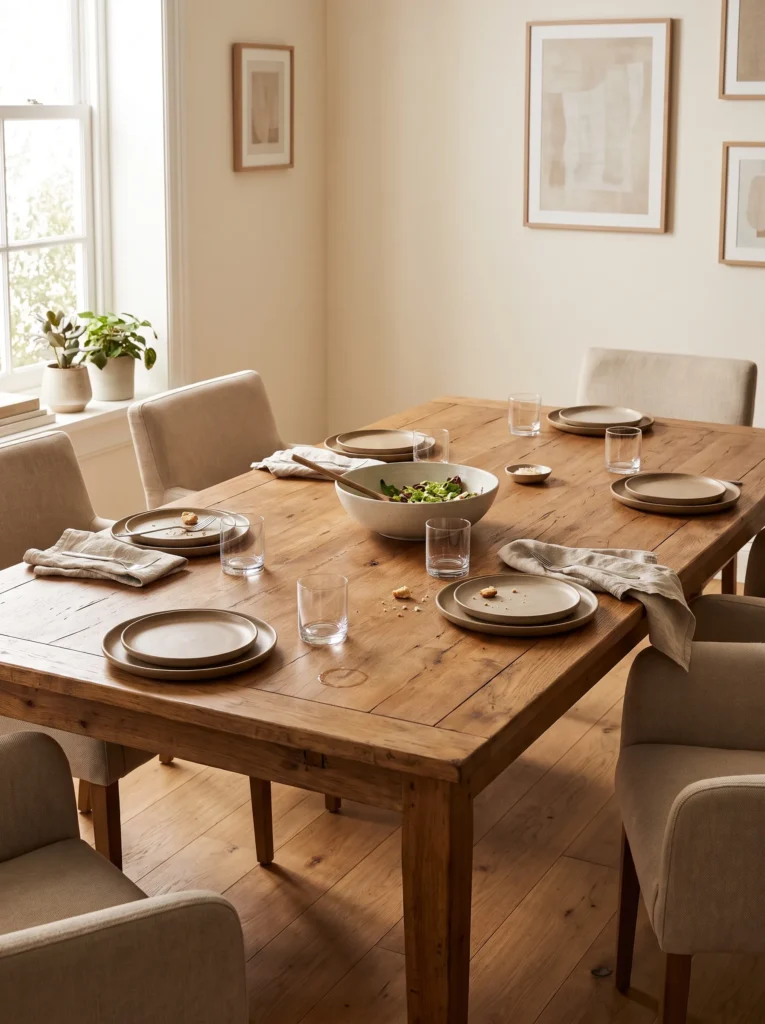
Natural wood dining table styled for everyday family meals in a warm dining room.

Material affects much more than appearance.

A solid wood table can bring warmth and character and may develop a beautiful patina over time.

Engineered materials can offer different combinations of durability, consistency, and maintenance.

Glass can make a small room feel visually lighter but usually requires more frequent cleaning to keep fingerprints and marks under control.

Stone surfaces can create a substantial, sophisticated look but may be heavier and require specific care.

Instead of asking which material is universally best, ask:

What does this table need to survive in my home?

Think about children, pets, frequent entertaining, hot dishes, spills, cleaning habits, and how much maintenance you’re willing to accept.

Don’t Choose a Table That’s Too Large Just Because You Can Fit It

This is one of the most common dining-room mistakes.

You measure the room.

You discover that a 72-inch table technically fits.

So you buy it.

But once the chairs are pulled out, the walkway becomes narrow and the room feels packed.

The fact that furniture fits on a floor plan doesn’t necessarily mean it fits comfortably into real life.

Leave some breathing room.

A slightly smaller table can often make the entire dining area feel more spacious, while still providing enough room for everyday meals.

And Don’t Go Too Small Either

The opposite mistake is choosing the smallest table possible because the room is compact.

If everyone constantly bumps elbows, serving dishes have nowhere to go, or you can’t comfortably place plates and glasses, you’ve saved floor space at the expense of usability.

A dining table should still feel generous enough for its primary purpose.

If you’re struggling between two sizes, think about which limitation would bother you more:

Less walking space?

or

Less dining space?

Your answer usually makes the decision clearer.

A Simple Way to Test Your Table Before Buying

You don’t need to rely entirely on measurements printed on a product page.

Use painter’s tape to recreate the tabletop footprint on your floor.

Then add the approximate space occupied by the chairs.

Walk around the arrangement.

Open nearby doors.

Pull chairs out.

Imagine someone sitting down while another person walks behind them.

If possible, place temporary objects at the table corners so you can experience the visual footprint as well as the physical one.

This five-minute exercise can reveal problems that a furniture photograph never will.

Make the Table Work With the Rest of the Room

The dining table shouldn’t feel like an isolated purchase.

Look at what surrounds it.

A large sideboard may require additional clearance.

A pendant light should be appropriately positioned above the table.

A rug needs to extend far enough beyond the chairs to remain functional when they are pulled out.

The colors and materials should also relate to the surrounding furniture.

This doesn’t mean everything needs to match.

In fact, a dining room often feels more considered when the table, chairs, lighting, and surrounding finishes complement rather than perfectly coordinate with one another.

The goal is visual relationship, not uniformity.

Before You Commit, Picture a Normal Dinner

Don’t imagine the table in an empty room.

Imagine it on a busy evening.

Plates are on the surface.

Someone is sitting at each chair.

A child gets up.

Someone needs to walk behind the table.

A serving dish needs to be placed in the middle.

The kitchen is being used.

A guest arrives.

Now look at the table.

Does the room still feel comfortable?

If it does, you’re probably looking at the right size and shape.

If everything suddenly feels compressed, the table may be asking too much of the room.

Choose the Table That Makes the Room Easier to Live In

The right dining table doesn’t simply give you somewhere to eat.

It should make the room feel natural to move through, comfortable to gather in, and flexible enough for the way your household actually lives.

Start with the space.

Then consider clearance, seating, shape, chairs, material, and everyday use.

You may discover that the table you originally imagined isn’t the best fit—and that’s a good thing.

Because the goal isn’t to find the biggest table that fits your dining room or the trendiest one in the showroom.

It’s to find the table that makes the entire room work better.

Leave a Comment

Your email address will not be published. Required fields are marked *