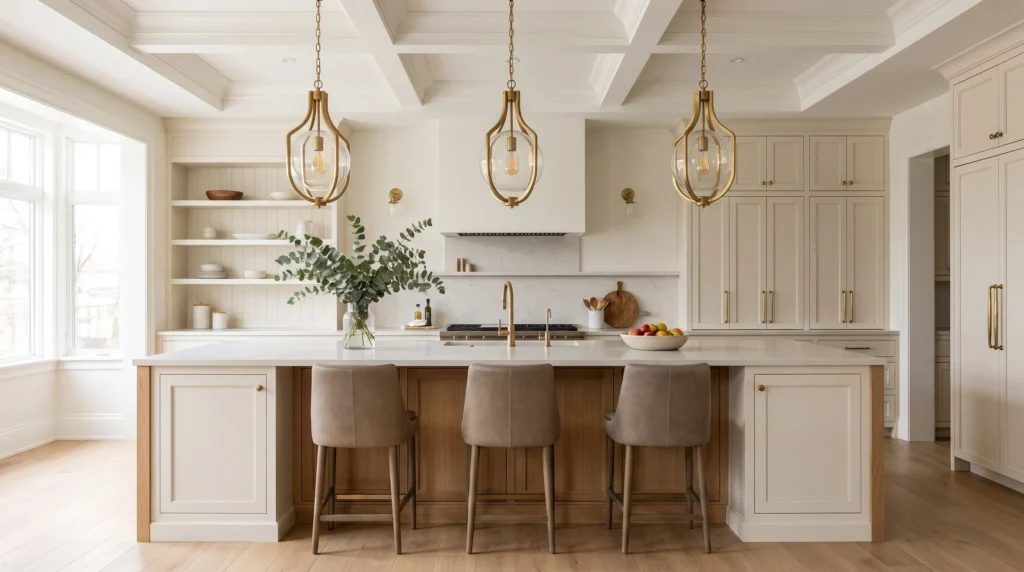
A kitchen island can look beautifully finished on paper and still feel slightly wrong once the pendant lights are installed.
Sometimes the fixtures seem to hang too low, interrupting the view across the kitchen. Other times, they disappear into the ceiling and provide little useful light over the work surface.
The difference can come down to just a few inches.
Pendant height isn’t only a question of where a light looks attractive. It affects how comfortably you can use the island, how much light reaches the countertop, and how the entire kitchen feels when you’re standing or sitting nearby.
That’s why the right height shouldn’t be chosen from the fixture alone.
Your ceiling height, pendant size, island dimensions, seating arrangement, and sightlines all play a role.
The good news is that you don’t need to guess.
A simple starting measurement can get you close, and a few practical adjustments can help you find the height that actually works in your kitchen.
Start With the Countertop, Not the Ceiling
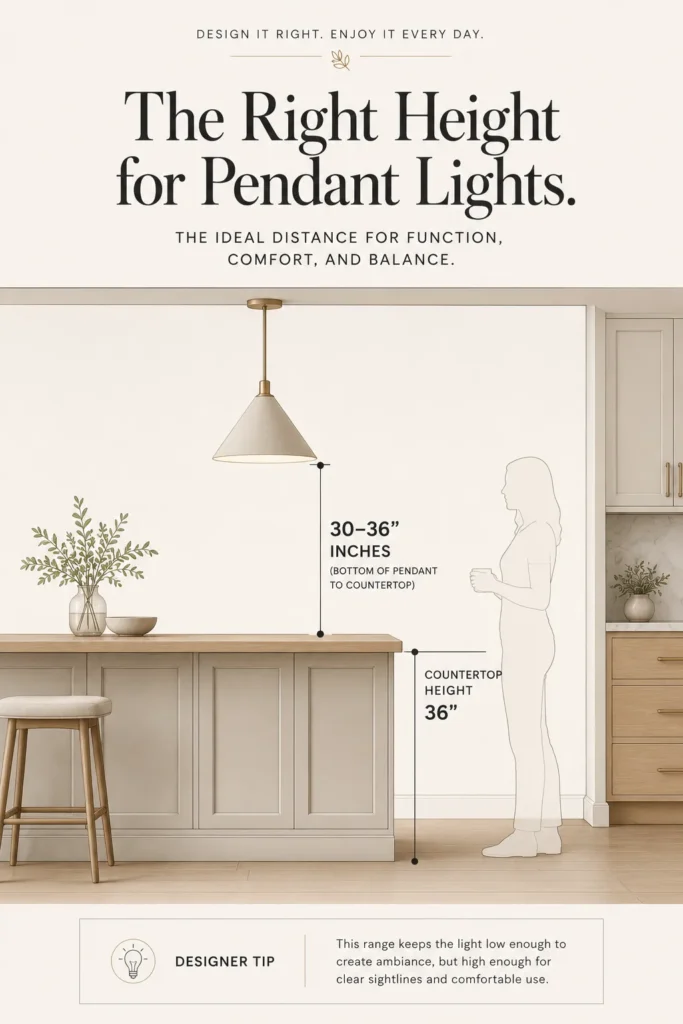
When measuring pendant height, the most useful reference point is the top of the kitchen island countertop.
For a typical kitchen, the bottom of the pendant is generally positioned around 30 to 36 inches above the countertop.
Think of this as a starting range rather than an absolute rule.
A pendant at 30 inches and one at 36 inches can create noticeably different experiences, even though both fall within the commonly used range.
The lower position can feel more intimate and concentrated, while the higher position opens up the sightline across the kitchen.
Your goal is to find the point where the light provides useful illumination without becoming an obstacle.
Why Those Extra Few Inches Matter
Imagine sitting at the island talking to someone across the kitchen.
If the pendant hangs too low, you may find yourself looking around it rather than through the space.
If it hangs too high, the fixture can lose some of its visual presence and may not distribute light as effectively across the countertop.
This becomes particularly noticeable when the island is also used for:
- Preparing food
- Eating meals
- Working
- Helping children with homework
- Entertaining guests
A pendant isn’t simply a decorative object suspended from the ceiling.
It occupies the space between the person and the surface they’re using.
That’s why sightlines should be considered alongside the measurement.
Use the 30–36 Inch Range as Your Starting Point
For a standard-height island, begin by measuring approximately 30 to 36 inches from the countertop to the bottom of the pendant.
Then step back.
Don’t immediately decide that the measurement is right just because it falls within the recommended range.
Look at the light from several positions around the kitchen.
Stand at the island.
Walk toward it from the surrounding room.
Sit on one of the island stools.
Look across the countertop.
You’re checking whether the fixture feels appropriately scaled and whether it interferes with the visual connection between different areas of the kitchen.
This is particularly important in open-plan homes where the island is visible from the living or dining area.

Let Your Ceiling Height Influence the Final Position
The 30–36 inch measurement is a useful starting point, but ceiling height can influence how the installation feels.
Standard 8-Foot Ceilings
With an 8-foot ceiling, staying closer to the standard range usually works well.
Hanging pendants too low can make the kitchen feel visually compressed, particularly when the fixtures themselves are large.
If the pendants are substantial, the higher end of the range may provide a more comfortable sightline.
9-Foot Ceilings
A taller ceiling gives you more visual breathing room.
You can still use the same countertop-to-pendant measurement, but larger fixtures or longer cords can sometimes be accommodated without making the kitchen feel crowded.
The important thing is not to automatically lower the pendants simply because the ceiling is higher.
The countertop remains the primary reference point.
10-Foot Ceilings and Higher
This is where proportion becomes especially important.
A very high ceiling can make standard-sized pendants look disconnected from the island if they’re hung too high overall.
Instead of simply increasing the gap between the countertop and the light, consider the overall scale of the fixture and its relationship to the island.
A larger kitchen may benefit from larger pendants, longer suspension, or a more substantial lighting arrangement.
The goal is to visually connect the ceiling and island rather than allowing the lights to float somewhere in between.
The Island’s Size Changes the Conversation
Pendant height doesn’t exist in isolation.
A long island with a generous countertop can support a different lighting arrangement from a compact island in a smaller kitchen.
For example, three small pendants may work beautifully over a long island, while two larger fixtures may create a better sense of proportion over a shorter surface.
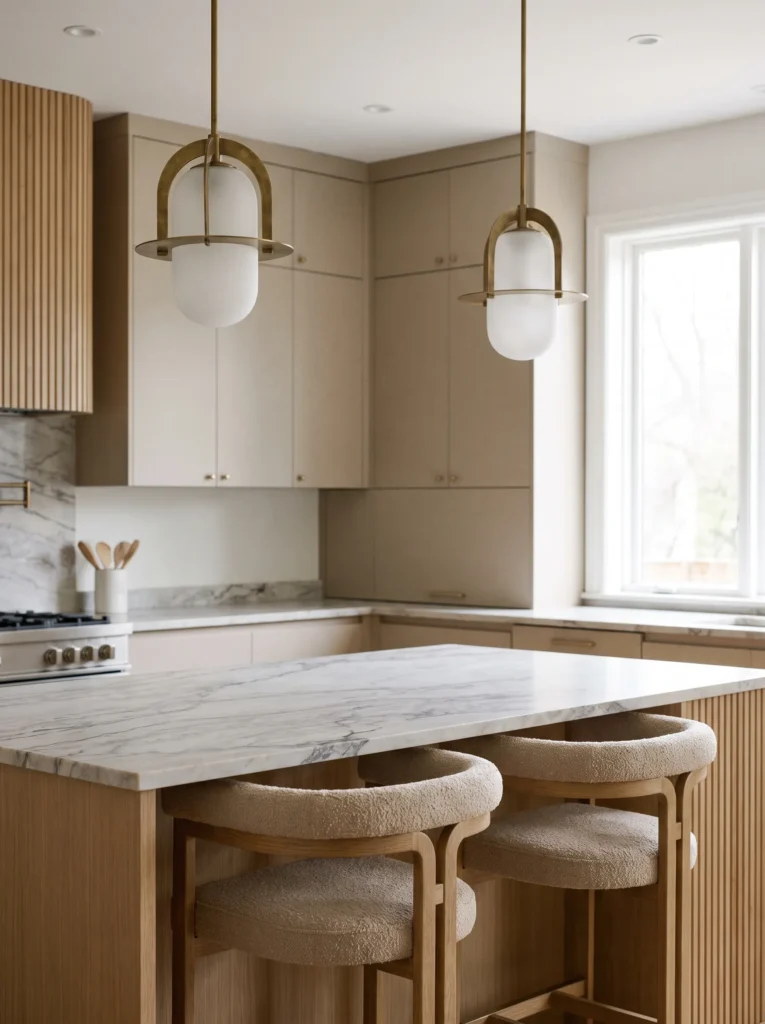
This is where lighting should be treated as part of the overall kitchen island design, rather than as an isolated purchase.
Don’t Forget the People Sitting at the Island
This is one of the easiest details to overlook.
If your island has bar or counter seating, the pendant needs to work for people who are sitting down, not only those standing at the countertop.
Sit on one of the stools and look toward the opposite side of the kitchen.
Can you see comfortably beneath or around the fixture?
Does the light sit directly in your line of sight?
Does it feel like the pendant is hovering over your head?
A height that looks perfect while standing can feel completely different when you’re seated.
This simple test is often more useful than relying on a measurement alone.

A Simple Way to Find Your Starting Height
If you’re installing new pendants and haven’t finalised the position yet, don’t commit immediately.
Try this instead:
Measure 30–36 inches above the countertop.
Then temporarily mark the proposed bottom of the fixture using painter’s tape, a piece of cardboard, or another safe visual reference.
Stand.
Sit.
Walk around the island.
Look toward the kitchen from adjacent rooms.
If the fixture feels too dominant, move your proposed position slightly higher.
If it feels visually disconnected from the island or doesn’t provide the illumination you need, you may need to reconsider the fixture size, placement, or height.
The point is to test the relationship before drilling holes or finalising the installation.
Spacing Matters Just as Much as Height
Getting the pendant height right is only half of the equation.
If you’re using two or three fixtures, the distance between them can determine whether the lighting feels balanced or cluttered.
A beautiful pendant arrangement should look intentional from both the kitchen and the adjoining rooms.
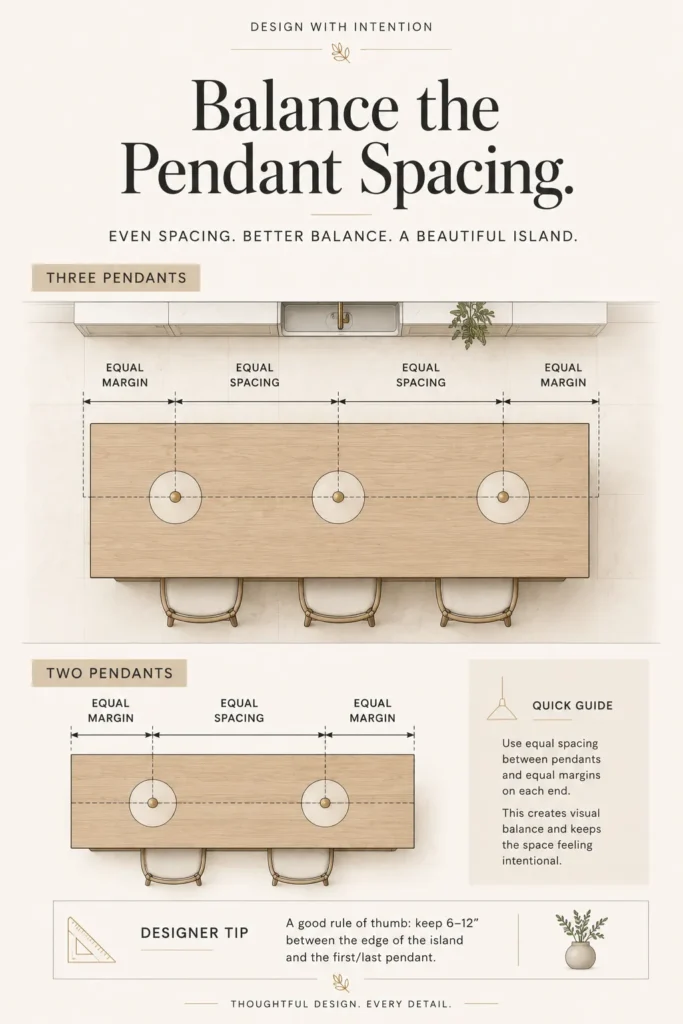
Two Pendants Over an Island
Two pendants often work well over a medium-sized island.
Instead of placing them directly at the outer edges, leave some breathing room between the fixtures and the ends of the island.
A useful starting point is to position the pendants so their visual weight is distributed across the main working area rather than concentrated in the centre.
The exact distance depends on the size of the pendants.
Large fixtures need more space.
Smaller fixtures can sit closer together.
Three Pendants Over a Longer Island
Three pendants can work particularly well when the island is long enough to accommodate them comfortably.
The key is consistency.
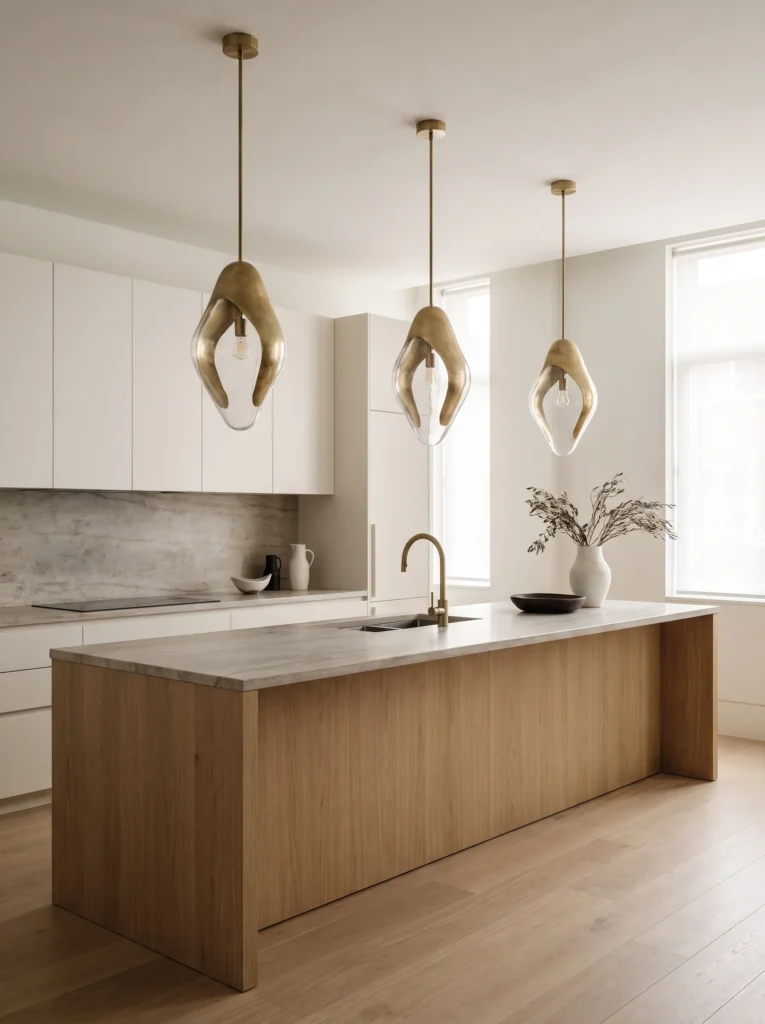
Rather than treating each pendant as an individual decoration, imagine the three fixtures forming one visual line across the island.
Keep the spacing reasonably even and make sure the outer fixtures don’t feel pushed too close to the ends.
If you have a large island, this arrangement can also provide more evenly distributed task lighting.

The Size of the Pendant Should Influence the Spacing
One of the most common mistakes is choosing the number of pendants first and the size second.
It should work the other way around.
A large sculptural pendant may need considerable visual breathing room. Several small glass pendants can usually be grouped more closely.
Think about the diameter of each fixture as well as the distance between them.
For example, three oversized pendants placed at the same spacing you’d use for three small fixtures can make an island feel crowded.
On the other hand, tiny pendants spread too far apart may lose their visual connection to the island.
The objective isn’t to follow one universal measurement.
It’s to create a rhythm that feels proportional to the countertop below.

Don’t Let the Pendants Compete With the Kitchen
Pendant lights are often chosen because they make a statement.
That’s perfectly fine.
But the statement should support the kitchen rather than compete with everything around it.
If your kitchen already has strong elements—such as dramatic quartz or quartzite countertops, bold cabinetry, or distinctive hardware—a quieter pendant can allow those materials to remain part of the visual story.
On the other hand, a simple kitchen with restrained finishes may benefit from a more sculptural lighting fixture.
Think about the entire composition before deciding how much attention the pendants should attract.
Consider the Light the Fixture Actually Produces
A pendant can look perfect and still be disappointing if it doesn’t provide useful light.
Before buying, check where the light is directed.
A shade that points light mostly upward may create a beautiful atmosphere but provide less task lighting on the countertop.
A downward-facing fixture can concentrate light more effectively where you need it.
Transparent or open shades distribute light differently from opaque shades.
So don’t judge the fixture only by its appearance when it’s switched off.
Consider what the kitchen will look like after dark, when the pendant is doing the job it was purchased to do.
Avoid Hanging Pendants Where They Become a Headache
A few placement mistakes are especially frustrating because you notice them every single day.
Too Low
The fixture interrupts sightlines and can feel intrusive when people stand or sit at the island.
Too High
The pendant can lose its relationship with the countertop and may feel disconnected from the space.
Too Close Together
Multiple fixtures begin to visually merge into one crowded cluster.
Too Far Apart
The arrangement can look scattered rather than intentional.
Too Large for the Island
The lighting overwhelms the countertop and makes the kitchen feel visually heavy.
Too Small for the Space
The pendants disappear against a large kitchen and fail to provide enough visual presence.
The Best Height Depends on How Your Kitchen Is Used
There is a reason you won’t find one measurement that works perfectly for every kitchen.
A family that uses the island primarily for food preparation may prioritise task lighting.
Someone who uses it mainly for casual meals may care more about comfortable sightlines while seated.
If the island is the centre of entertaining, the relationship between the pendants and the surrounding rooms becomes more important.
And if your kitchen opens directly into a living room, you should consider how the fixtures look from the other side of the space.
The right pendant height is therefore less about following a decorating rule and more about finding the point where function, proportion, and comfort meet.
A Quick Height and Spacing Reference
| Decision | Starting Point |
|---|---|
| Pendant height | 30–36 inches above countertop |
| Two pendants | Distribute evenly across the island |
| Three pendants | Maintain consistent visual spacing |
| Large pendants | Allow more breathing room |
| Small pendants | Can be grouped more closely |
| Seating at island | Check sightlines while seated |
| Tall ceilings | Consider overall fixture scale, not just height |
| Task lighting | Check where the fixture directs light |
These are starting points rather than rigid rules.
The proportions of your island, the size of your pendants, and the way you use the space should determine the final arrangement.
The Tape Test Is Worth Doing
Before the electrician makes the final installation, mock up the pendant positions.
This doesn’t need to be complicated.
Mark the approximate bottom of each fixture and temporarily indicate the positions on the ceiling or suspension point.
Then use the kitchen normally.
Stand at the island.
Sit down.
Walk around it.
Look toward the kitchen from the living room.
Pay attention to whether the fixtures feel too low, too dominant, too close together, or visually disconnected from the island.
This simple test can reveal problems that aren’t obvious on a floor plan.
And if something feels wrong before installation, it’s much easier to move a temporary marker than to relocate electrical connections later.
Let the Island and the Lighting Work as One
Pendant lights shouldn’t look as though they were added to the kitchen at the very end.
Their height, spacing, size, and finish should feel connected to the island underneath them.
That’s especially important when the island is one of the largest visual elements in an open-plan kitchen.
Start with the countertop.
Find your approximate height.
Consider the people using the island.
Then adjust for fixture size, spacing, ceiling height, and the way light actually falls.
The 30–36 inch range gives you a useful starting point, but the best installation is the one that feels comfortable when you’re actually living with it.
Before the Ladder Comes Out
There’s one final test worth making before the installation becomes permanent.
Stand where you normally stand in the kitchen.
Then sit where you normally sit at the island.
Look across the room.
If the pendant sits comfortably within your field of view without blocking conversation, feels appropriately connected to the countertop, and provides the kind of light you actually need, you’re probably close to the right position.
The goal isn’t to make the pendant hang at a perfect number simply because a guide says it should.
It’s to make the entire lighting arrangement feel like it belongs exactly where it is.
That is what makes good kitchen lighting almost disappear into the design—while quietly making the island more useful every day.