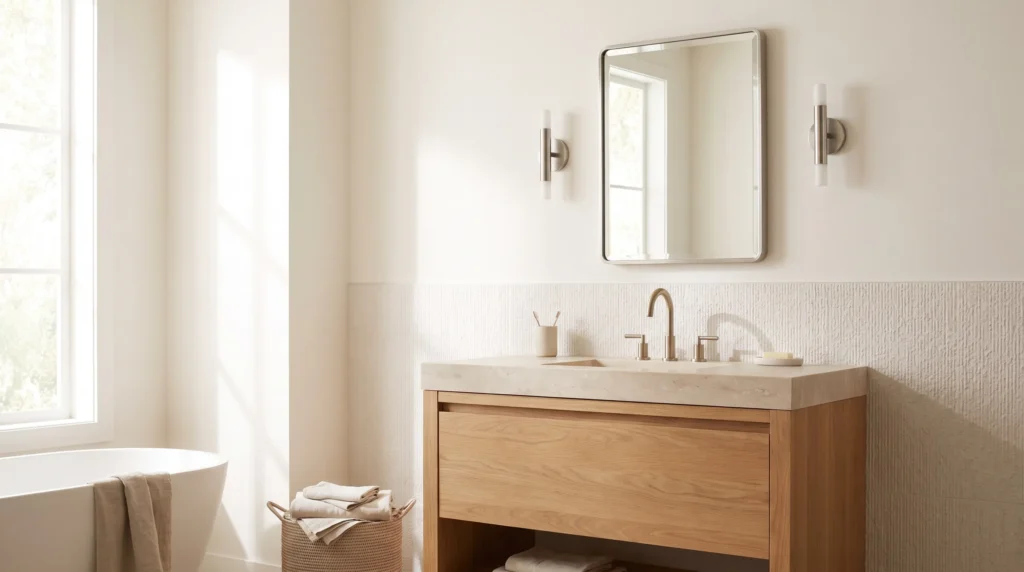
A bathroom mirror can be beautiful on its own and still look wrong above the vanity: too narrow leaves the wall unfinished; too wide fights the lighting, cabinets, and architecture; even the right width fails mounted too high or too tight. The vanity, wall, lighting, and mirror must work as one composition. Start with the vanity’s width — a few inches narrower than the vanity is a common starting point — but don’t stop there. Sinks, wall space, ceiling height, lighting, and shape all change the answer.
Don’t Start With the Mirror
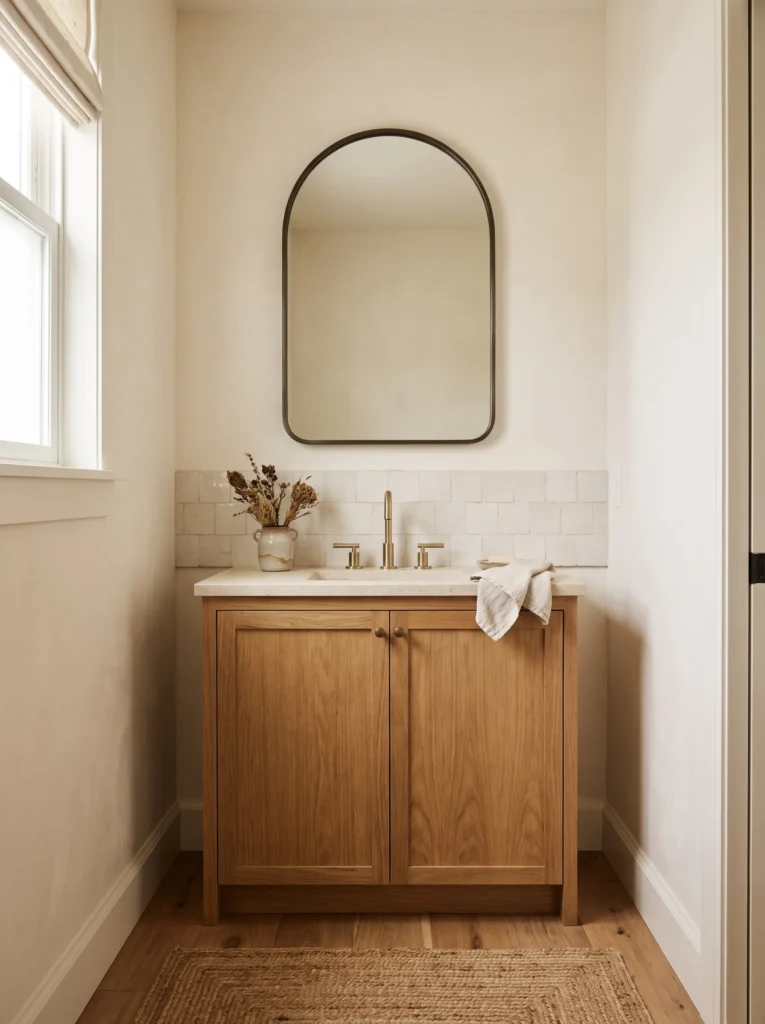
Look at the vanity first: overall width, sink position, faucet, countertop, surrounding walls. A mirror somewhat narrower than the vanity usually balances well, leaving visible countertop or wall on either side. But a wide, uncluttered wall can carry a larger mirror beautifully, while nearby sconces or cabinets may demand a smaller one. Vanity width is the starting point, not the formula.
Match the Vanity Configuration
Single vanity: one centered mirror is simplest when the sink and faucet sit in the middle; a wider mirror can open up a small bathroom. Keep the mirror visually connected to the sink.
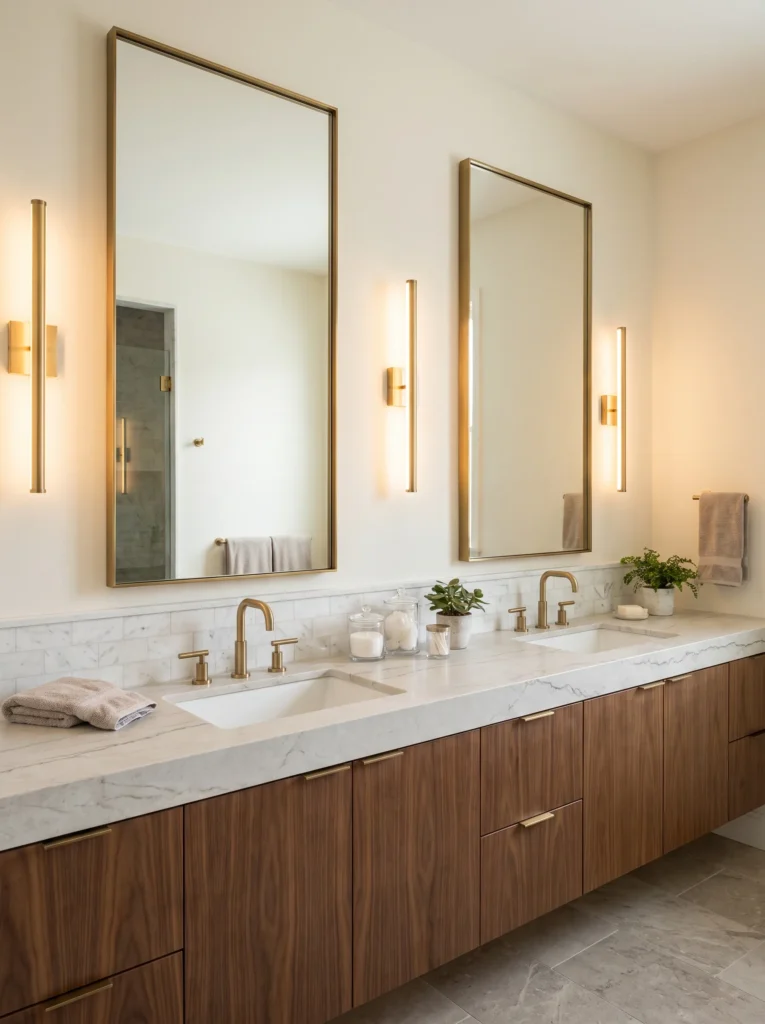
Double vanity: one large mirror spanning both sinks (clean, continuous, widens the wall — great for contemporary/minimalist), two separate mirrors (each sink gets its own zone; ideal with sconces between or beside them), or one wide mirror with lighting around it. No universal winner — it depends on wall width, lighting, and the look you want.
A Wide Vanity Doesn’t Need a Huge Mirror
A 72-inch vanity doesn’t demand a 72-inch mirror. Sconces on either side, tall nearby cabinets, a window, a niche, substantial countertop edges — these all compete for the wall. A slightly narrower mirror creates breathing room. The goal isn’t maximizing dimensions; it’s visual balance.
Read the Wall Before Choosing Width
The same vanity needs different mirrors on different walls. Wide uninterrupted wall: more freedom. Narrow wall or vanity wedged between walls: measure usable width, not the whole wall. Map sconces, medicine cabinets, windows, shelving, outlets, wall-mounted faucets, cabinets, and doors — a mirror that looks perfect online can fail once every surrounding element is accounted for.
Let Lighting Set the Size
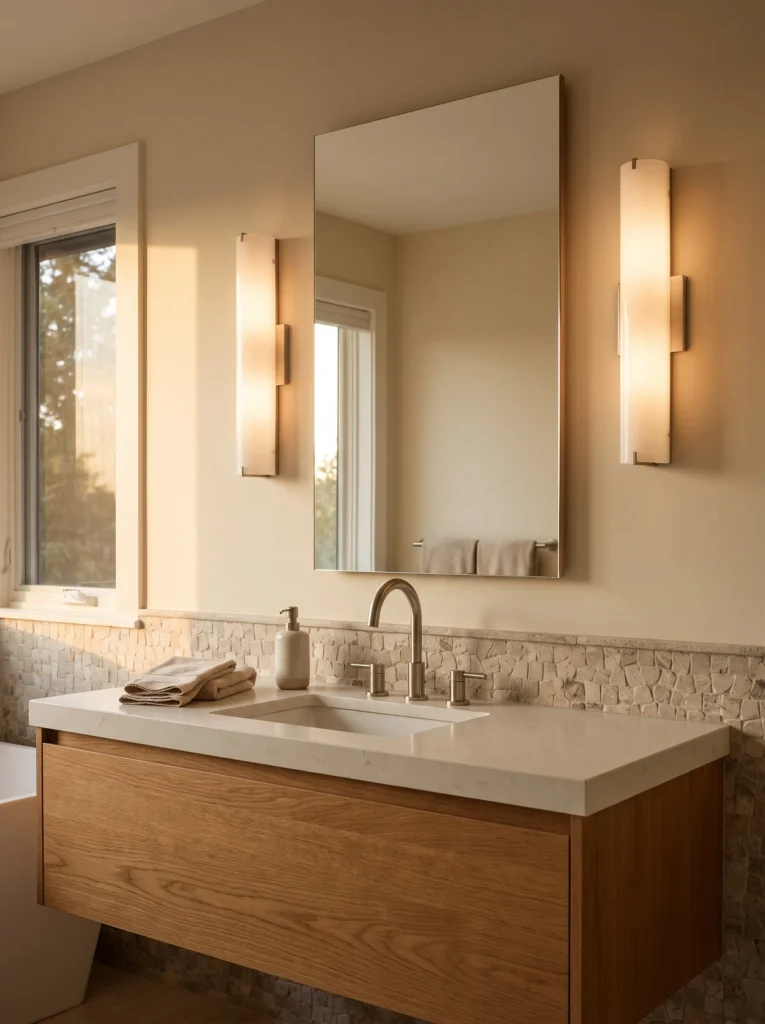
Lighting kills more “perfect” mirror plans than anything else. Sconces beside the mirror need wall space too; a wall-filling mirror leaves no room for them. Oversized mirror with overhead lighting reads entirely differently. Plan the lighting before ordering the mirror — especially on double vanities where fixtures multiply. For style ideas, see our bathroom mirror ideas guide.
Height Matters as Much as Width
Too short leaves awkward empty wall; too tall fights lighting and cabinetry. Weigh vanity height, ceiling height, sink position, faucet design, lighting, user height, and available wall. Taller mirrors suit high ceilings; compact mirrors suit small bathrooms.
Shape Changes the Proportion
Rectangular is the safe starting point — it follows the vanity’s geometry. Round softens straight-line bathrooms and suits compact vanities. Arched adds architectural character across traditional to contemporary styles. Pill-shaped splits the difference: round softness with more usable reflective area. Don’t choose by fashion — choose what complements the room’s existing lines.
Small Bathroom? Consider Going Bigger
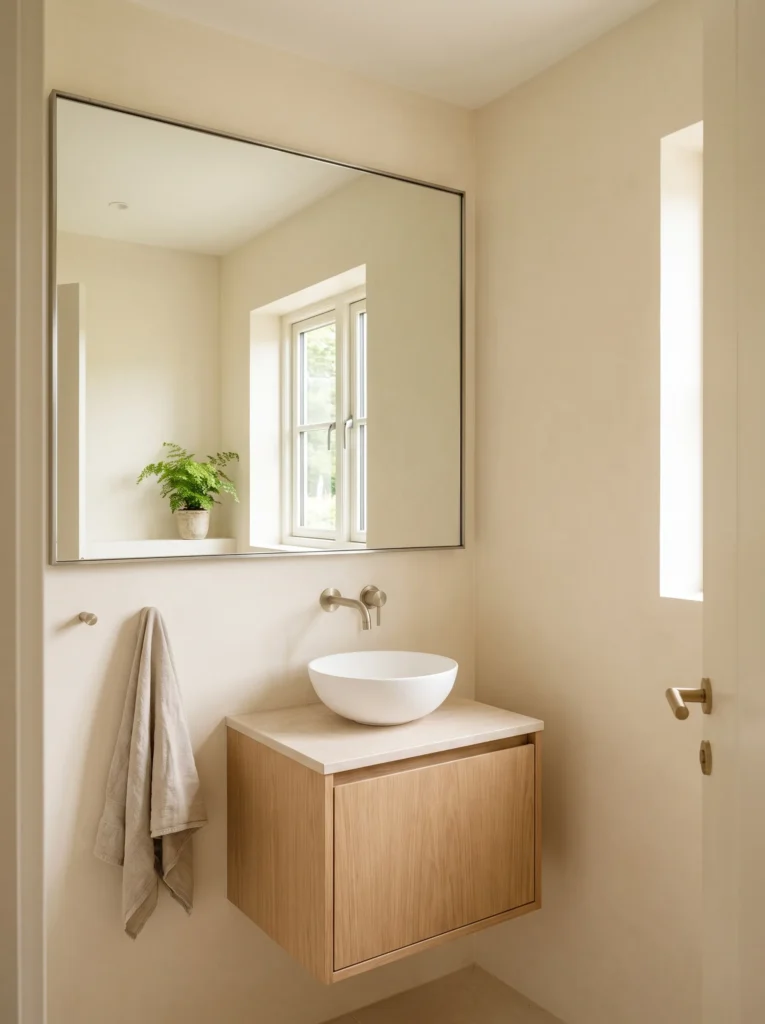
A relatively generous mirror reflects light and visually expands a compact bathroom — provided the wall stays simple and the mirror stays proportional to the vanity. Right-sized large beats timid small when there’s no clutter competing for the wall.
Don’t Forget Faucet and Backsplash
The faucet, backsplash, countertop, and mirror share one small visual zone. A high backsplash eats mirror space; a wall-mounted faucet changes vertical proportions. Treat the whole vanity wall as one composition — the mirror should belong to it, not sit above it as an afterthought.
The Decision Framework: Vanity → Wall → Lighting → Mirror
1. Vanity dimensions (starting proportion). 2. Usable wall space. 3. Lighting and fixtures. 4. Then finalize the mirror. Two identical 60-inch vanities can need very different mirrors — one with sconces and a narrow wall, one with a wide open wall. The vanity tells you where to start; the room tells you where to finish.
Test Before You Order
Painter’s tape on the wall: mark the mirror’s approximate width and height, step back, view from the doorway, then stand at the vanity. Check the relationship to sink, lighting, backsplash, and walls. For round or arched mirrors, tape the overall footprint. This reveals too-small, too-dominant, too-high, too-low, or too-close-to-fixtures before you spend a dollar.
Quick Answers
How wide should a bathroom mirror be compared to the vanity?
A common starting point is a few inches narrower than the vanity — but treat it as a guide, not a rule. Wall space, sconces, cabinets, and ceiling height can all push the answer wider or narrower.
One mirror or two for a double vanity?
One large mirror reads clean and contemporary and visually widens the wall; two mirrors define each sink’s zone and pair beautifully with sconces. Choose based on wall width, lighting plan, and style.
Can a mirror be wider than the vanity?
Occasionally, yes — on a wide, simple wall, a generous mirror can expand a small bathroom visually. But it should still feel proportional to the vanity and leave room for lighting and other wall elements.
Affiliate Disclosure: As an Amazon Associate, I earn from qualifying purchases. If you click a link and buy, I may receive a small commission at no extra cost to you. Thank you for supporting my content!