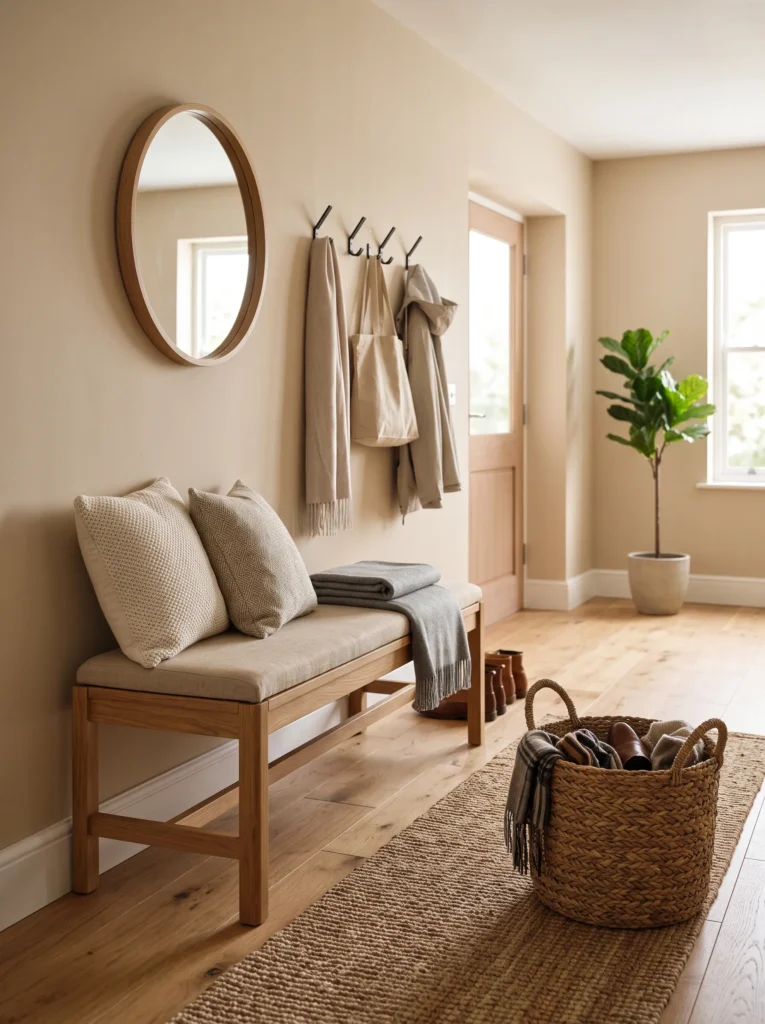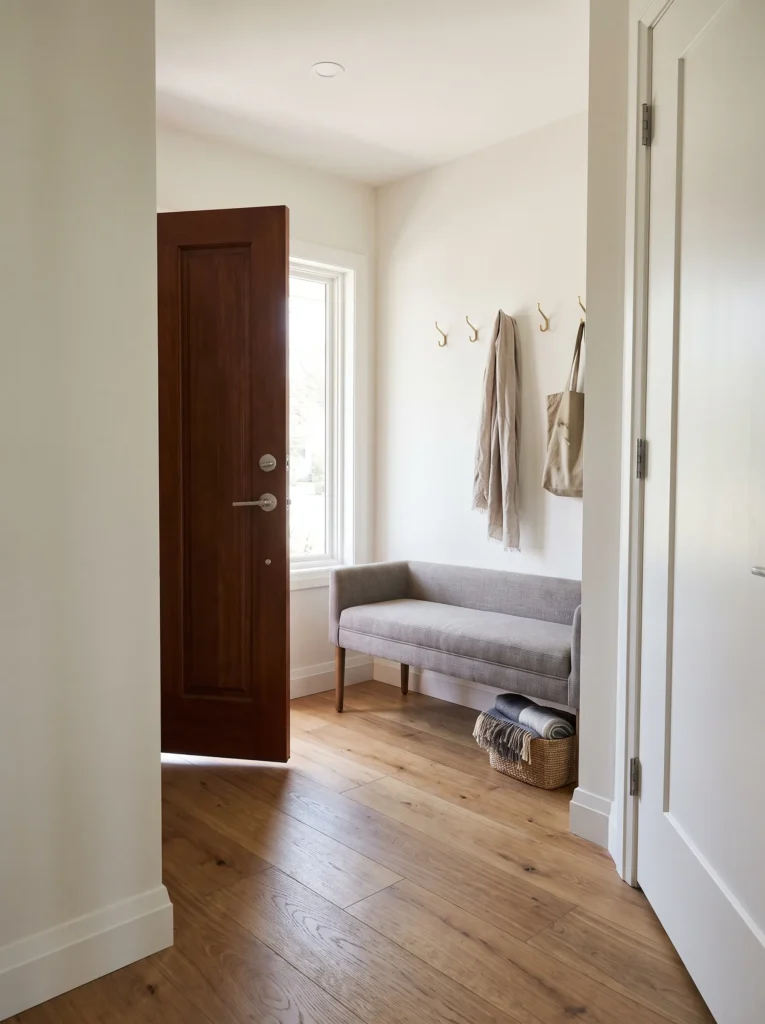
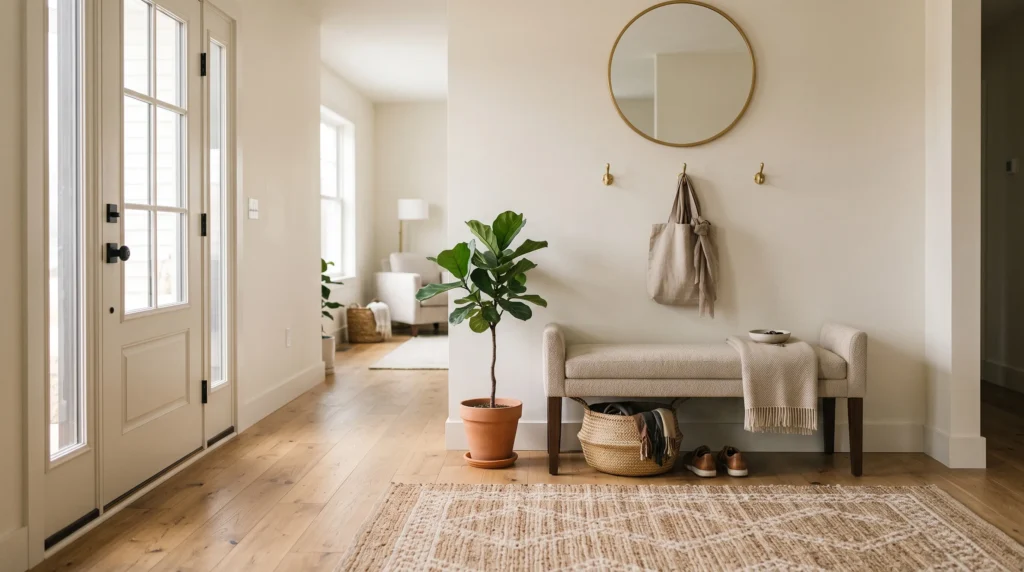
Well-proportioned entryway bench with comfortable space around it.

Entryway Bench Size Guide: Finding the Right Fit for Your Space

An entryway bench can make a small foyer feel more useful, but choosing one isn’t as simple as finding a style you like.

A bench that looks perfectly proportioned in a furniture showroom can feel surprisingly bulky once it’s sitting beside your front door. Another may technically fit the wall but leave too little room to walk past it comfortably.

The important measurements aren’t complicated. You need to think about height, depth, length, and the space that remains around the bench.

The right combination depends on how you use your entryway.

If the bench is mainly for taking off shoes, comfort matters most. If it also needs to store baskets, shoes, and bags, depth and clearance become more important. And if you’re working with a narrow hallway, saving a few inches of floor space can make a noticeable difference.

Instead of choosing an entryway bench by appearance alone, start with the space and work backward from how you want the bench to function.

Start With the Width of Your Entryway

Before looking at bench dimensions, measure the wall where you plan to place it.

Don’t measure only the empty wall. Look at everything competing for that space.

Check the position of:

  • The front door and its swing
  • Nearby doors
  • Stairways
  • Radiators or vents
  • Electrical outlets
  • Wall trim
  • Existing furniture
  • Coat hooks or cabinets
  • The main walking path

A bench may fit comfortably along the wall while still interfering with how people move through the entry.

This is why wall length isn’t the same thing as usable bench length.

Leave enough visual and physical breathing room around the bench rather than pushing it from one wall edge to another.

For many homes, a bench around 36 to 48 inches long is a practical starting point, while larger entryways can comfortably accommodate longer designs.

But the best length is ultimately the one that fits your wall and your daily routine.

The Height That Usually Feels Right

For an entryway bench that people will actually sit on, 18 to 20 inches high is a useful general range.

That puts the seat close to the height of many familiar chairs, making it comfortable for sitting down to remove shoes or pull on boots.

A lower bench can work beautifully in a relaxed or child-focused space, but adults may find it less comfortable when they need to stand back up.

A taller bench can look elegant, but it may make bending forward to deal with shoes more awkward.

So if the bench is primarily decorative, height is mostly a design decision.

If it’s part of your everyday routine, comfort should determine the height before appearance does.

A useful test

If you’re buying a bench in person, sit on it before deciding.

Place both feet comfortably on the floor and imagine putting on or removing your shoes.

If you naturally feel balanced rather than cramped or perched too high, you’re closer to the right height.

Entryway bench with a comfortable standard seating height for putting on shoes.

Depth Matters More Than Most People Expect

If you’re working with a narrow entryway, depth may be the measurement that matters most.

A bench that extends too far into the room can turn an otherwise comfortable hallway into a tight passage.

A depth around 15 to 18 inches is a practical range for many entryway benches, while shallower designs can be particularly useful in narrow corridors.

The deeper the bench becomes, the more generous the seating can feel—but the more floor space it consumes.

That’s why a deep upholstered bench isn’t automatically a better bench.

If your entryway is narrow

Prioritize:

Shallow depth → clear walkway → comfortable enough seating

rather than:

Deep seat → maximum cushion → crowded hallway

A slim bench can actually look more intentional in a small foyer because it doesn’t visually overpower the passage.

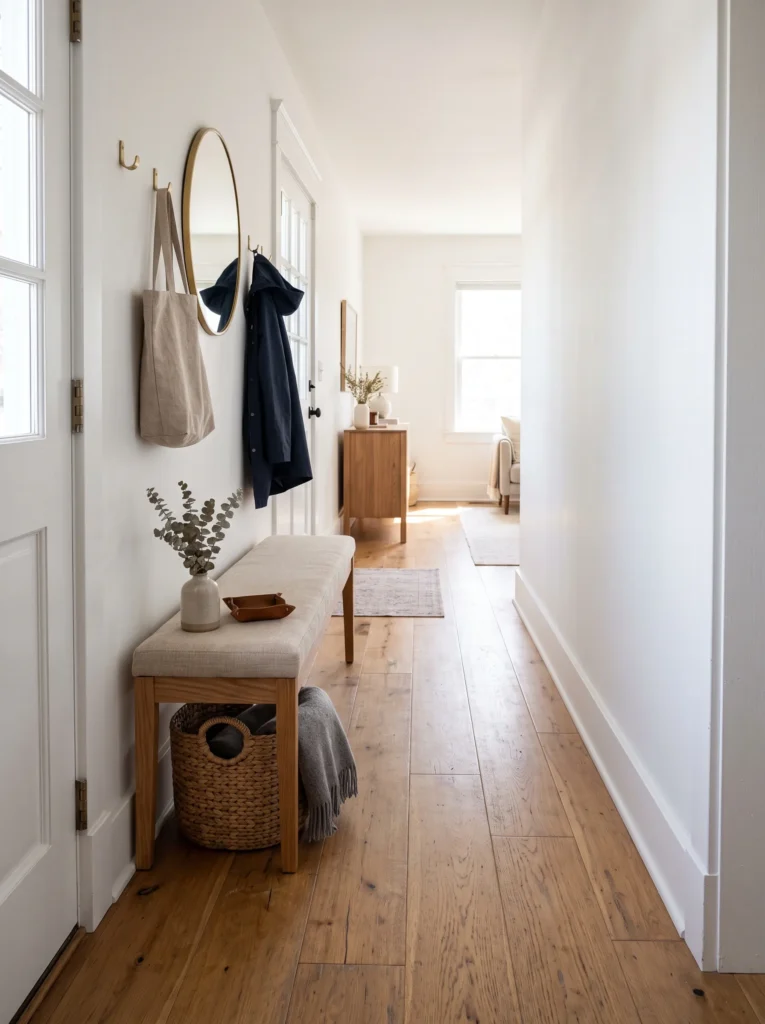
Shallow entryway bench leaving comfortable walking space in a narrow hallway.

Choose the Length Based on How You Will Use It

Length is where your lifestyle becomes part of the sizing decision.

If you’re the only person using the bench to put on shoes, you may not need a large piece of furniture.

If several family members regularly use the entryway at the same time, a longer bench becomes more useful.

Think about the difference between these situations:

Small household or compact foyer

A bench around 30 to 36 inches can provide a dedicated place to sit without consuming much wall space.

Two-person seating

A bench around 42 to 52 inches can provide more comfortable side-by-side seating while remaining relatively compact.

Family entryway

A longer bench around 48 to 60 inches or more can make sense when several people use the space and the wall is large enough to support it.

The mistake is choosing the longest bench that fits.

Instead, choose the shortest bench that comfortably serves the number of people who actually use it.

That leaves more room for hooks, artwork, a mirror, or simply some breathing space around the furniture.

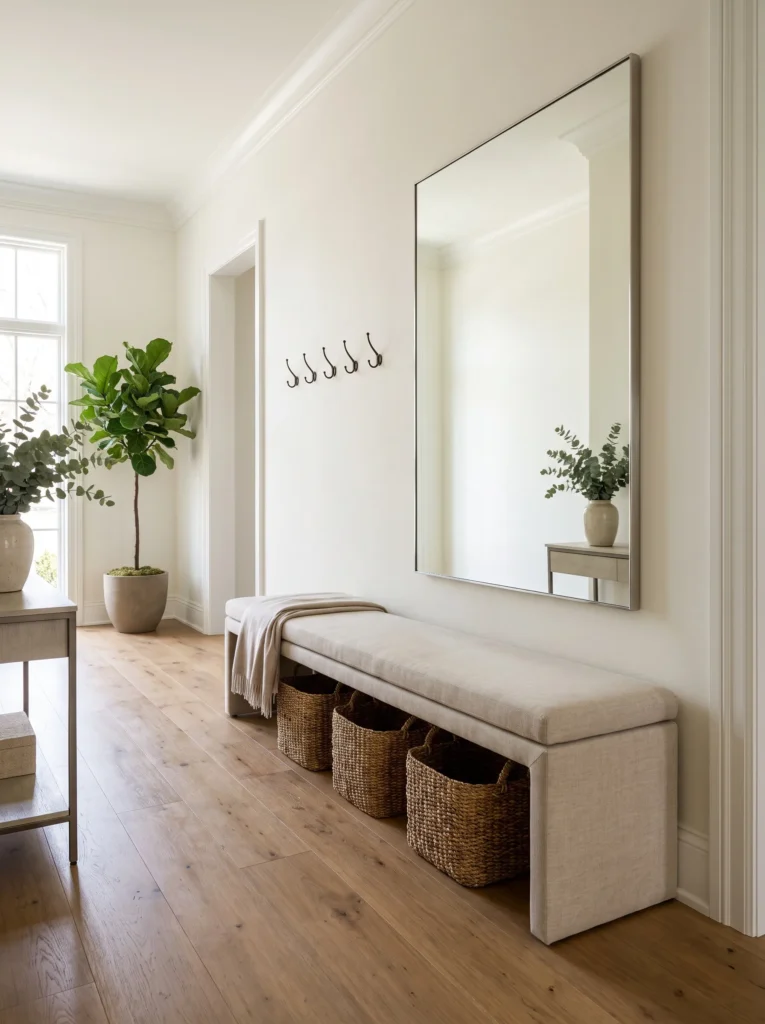
Long entryway bench proportioned to a wide wall with hooks and storage.

Don’t Forget the Walking Space in Front

A bench doesn’t exist by itself.

There’s also the space between the bench and everything else.

Before buying, imagine someone sitting on the bench while another person walks through the entryway.

Can they pass comfortably?

Can the front door open without hitting the bench?

Can someone carry groceries through the space?

Can a child drop a backpack without blocking the walkway?

These everyday scenarios matter more than whether the bench technically fits on the wall.

In a frequently used entryway, keeping a generous clear passage is one of the most important parts of the layout. Some current sizing references use around 36 inches of clear walking space as a practical target, although the exact requirement depends on the home’s layout and traffic pattern.

The narrower the entryway, the more valuable every inch becomes.

Decide Whether Storage Is Worth the Extra Depth

An entryway bench can do more than provide a seat.

It can also become a place for:

  • Shoes
  • Baskets
  • Bags
  • Dog accessories
  • Seasonal items
  • Children’s belongings

But storage changes the proportions.

A bench with deep cubbies may need more room than a simple open-leg bench.

Before choosing built-in storage, think about what you actually need to store.

If you only need somewhere to tuck away a few pairs of shoes, open space beneath the bench may be enough.

If the entryway constantly collects shoes, bags, and accessories, integrated storage may justify a slightly more substantial design.

The important thing is not to add storage simply because it’s available.

Storage should solve a problem—not create a larger piece of furniture than your entryway needs.

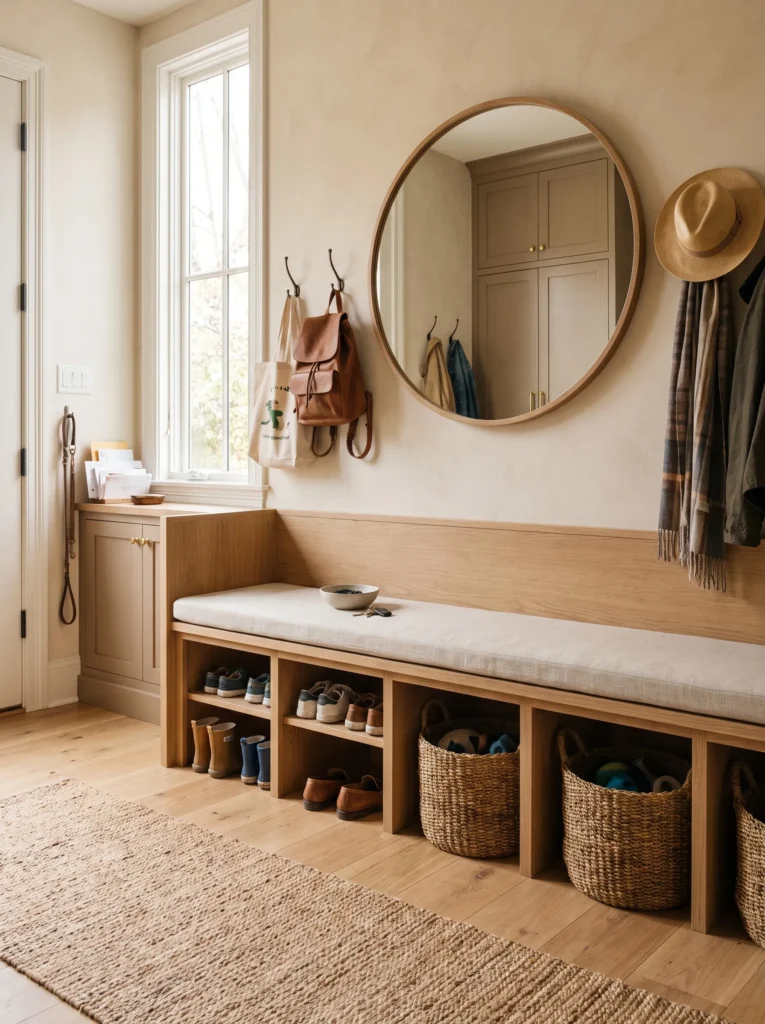
Entryway storage bench with baskets and shoes organized underneath.

Match the Bench to the Rest of the Entryway

A bench can be the right size on its own and still look wrong in the room.

That happens when its proportions don’t relate to the other elements around it.

Look at the wall, the door, nearby hooks, a mirror, artwork, or a console before deciding how large the bench should be.

A long bench beneath a short row of hooks can feel unbalanced. A tiny bench centered beneath a large mirror can look lost. And a deep bench beside a narrow doorway can make the entire entry feel tighter than it actually is.

The goal is not to fill the available wall.

It’s to create a composition where the bench feels like it belongs there.

If the Bench Sits Under Hooks, Think in Zones

Many entryways combine seating with coat storage.

In that arrangement, the bench becomes the lower part of a larger functional zone.

You don’t necessarily need the bench and the hooks to have identical widths, but they should feel visually related.

For example, a medium-length bench can sit comfortably beneath a slightly wider row of hooks, leaving enough room at either side for the arrangement to breathe.

This is particularly useful in family entryways where the bench, hooks, baskets, and shoes all need to work together.

The bench should support the storage system rather than compete with it.

A Small Entryway Needs a Different Strategy

When space is limited, don’t try to recreate the proportions of a large foyer with smaller furniture.

Instead, change the priorities.

For a narrow entryway, the order should usually be:

Clear walkway → appropriate depth → useful seating → storage → decorative details

This may mean choosing a simple bench with a slim profile rather than an upholstered storage bench with a substantial frame.

A shallow bench can provide enough room to sit while keeping the main path open.

In particularly narrow corridors, even a few inches of additional depth can change how the room feels.

That’s why measuring the usable floor area, rather than just the wall, is so important.

When a Storage Bench Makes Sense

Storage can be one of the biggest reasons to choose a bench in the first place.

But ask yourself what you’re actually trying to hide.

If the entryway only needs somewhere for a few pairs of shoes, an open shelf beneath the seat may be enough.

If you’re dealing with children’s shoes, bags, hats, and seasonal accessories every day, closed or basket-style storage can be much more valuable.

A storage bench is worth the extra visual weight when it solves a genuine organization problem.

Otherwise, a simple open bench may give you the same seating function while making the entryway feel lighter.

Think About What Happens When Someone Sits Down

One easy mistake is measuring the bench when it’s empty.

But the bench becomes deeper in practical terms once a person is sitting on it and using the space in front.

Someone may need to:

  • Sit down
  • Bend forward
  • Place a foot on the floor
  • Reach for a shoe
  • Stand back up
  • Move a bag out of the way

If the bench is positioned directly opposite another piece of furniture, this movement needs to be considered.

The entryway should still feel usable while someone is sitting on the bench.

This is especially important when the bench includes drawers or pull-out storage. Those features need additional operating space in front of them rather than merely fitting within the bench’s footprint.

Don’t Let the Bench Fight the Door

The front door should always get priority.

Before buying, open the door as far as it normally needs to swing.

Then consider the bench.

If the door passes close to the wall where the bench will sit, a deeper design may create an awkward collision point.

The same applies to nearby interior doors.

A bench that looks beautiful with every door closed can become frustrating if someone has to squeeze around it every time another room is opened.

In a compact entryway, door movement should be part of the furniture measurement—not an afterthought.

Entryway bench positioned without interfering with the front door swing.

Choose the Bench Shape for the Space

The simplest rectangular bench isn’t always the only option.

A curved or rounded bench can soften a tight entryway because it has fewer visually hard corners.

A wall-mounted bench can create more visible floor underneath, which can make the area feel lighter.

A built-in bench can use an awkward recess more efficiently than a freestanding piece.

And a narrow upholstered bench can add softness without requiring the depth of a large storage seat.

The best shape depends on what the architecture gives you.

Don’t force a standard furniture shape into a space that clearly wants something different.

What Size Works Best for Different Entryways?

There isn’t one universal “correct” bench length, but a few starting points can make the decision easier.

Very Small Entryway

About 24–36 inches long

Best when one person mainly needs a place to sit and the available wall is limited.

Average Entryway

About 36–48 inches long

A useful middle ground for a compact household or one-to-two-person seating area.

Larger Foyer

About 48–60 inches long

Better when the wall has enough space and more than one person regularly uses the bench.

Large Mudroom or Family Entry

60 inches or more

Useful when seating and storage are both important and the room can accommodate a larger piece.

These ranges are starting points, not requirements. Current sizing references commonly place many practical entryway benches in the 42–60 inch range, while smaller benches can work well in apartments and compact foyers.

Measure the Space in This Order

If you’re standing in your entryway with a tape measure, don’t start by measuring the wall and immediately ordering a bench.

Use this sequence instead.

1. Measure the available wall

Determine the maximum length that could physically fit.

2. Measure the entryway depth

Find out how much room exists between the bench wall and the opposite wall, door, or furniture.

3. Check the door swing

Open the door fully and identify any potential conflict.

4. Decide your minimum walkway

Don’t allow the bench to consume the circulation space simply because it fits.

Around 30–36 inches is commonly used as a practical clearance target, but the exact amount should reflect the home’s traffic pattern and the furniture opposite the bench.

5. Choose the bench depth

Only after considering the available circulation should you decide how deep the seat can be.

6. Choose the length

Finally, select the shortest length that gives you the seating and storage capacity you actually need.

This sequence prevents a common mistake: choosing a beautiful bench first and trying to make the room accommodate it afterward.

A Bench Should Earn Its Floor Space

The best entryway bench isn’t necessarily the largest, most expensive, or most decorative option.

It’s the one that earns the space it occupies.

If it gives you a comfortable place to sit, keeps shoes or bags organized, and still leaves the entryway easy to move through, it’s doing its job.

If it blocks the door, narrows the walkway, or becomes a dumping ground for clutter, even a beautiful bench is the wrong size.

Before you buy, stand in the entryway and imagine the bench actually being used—not just sitting against the wall.

Open the door.

Walk past it.

Sit down.

Reach for a shoe.

Imagine another person coming through behind you.

If all of those movements still feel natural, you’re probably close to the right proportions.

The Right Bench Is the One You Stop Noticing

A well-sized entryway bench doesn’t need to announce that it was carefully measured.

You simply walk in, sit down, take off your shoes, put your bag away, and keep moving.

That’s the real test.

Choose the height that feels comfortable, the shallowest depth that gives you useful seating, and the shortest length that serves the people who actually use the space.

Then leave enough room around it for the entryway to breathe.

When those proportions work together, the bench becomes more than another piece of furniture. It becomes part of the way the home functions from the moment you walk through the door.

Leave a Comment

Your email address will not be published. Required fields are marked *