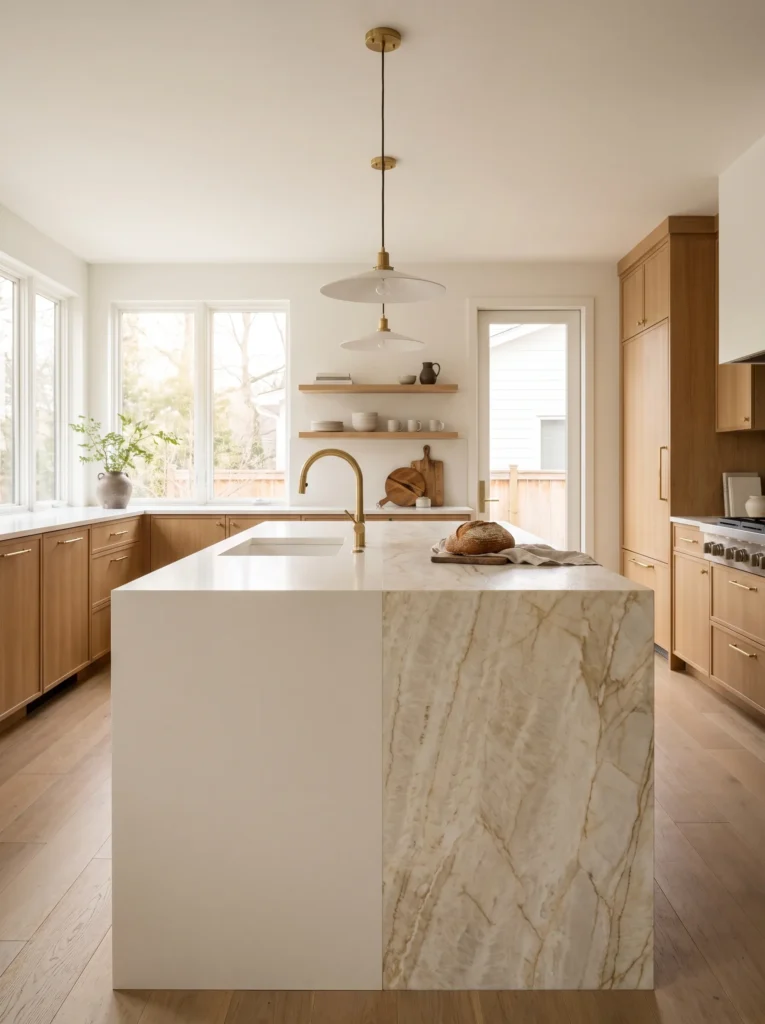
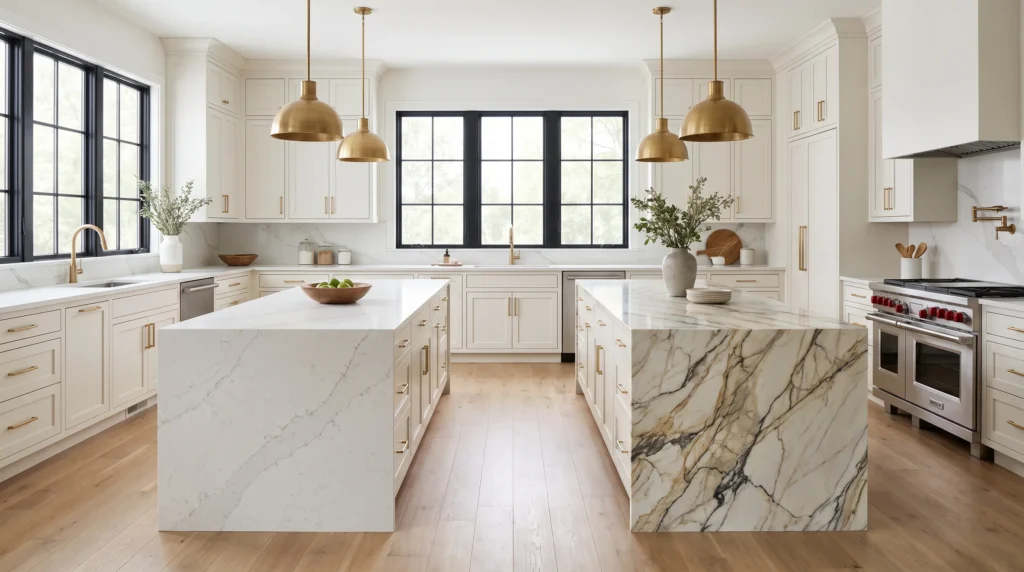
Walk through almost any kitchen showroom, and you’ll probably hear two countertop materials recommended again and again: quartz and quartzite.
At first glance, they can look surprisingly similar.
Both offer beautiful surfaces, impressive durability, and the ability to transform an ordinary kitchen into something that feels more refined.
That’s exactly why so many homeowners struggle to choose between them.
The decision isn’t simply about appearance.
It’s about how your kitchen functions every day.
Do you want a countertop that requires very little maintenance? Are you drawn to the character of natural stone? Is your kitchen constantly busy with cooking, children, or entertaining guests?
The answers to those questions matter far more than choosing whichever material happens to be trending.
This guide compares quartz and quartzite from the perspective of everyday living, helping you understand where each material performs best so you can invest with confidence.
Start With One Important Difference
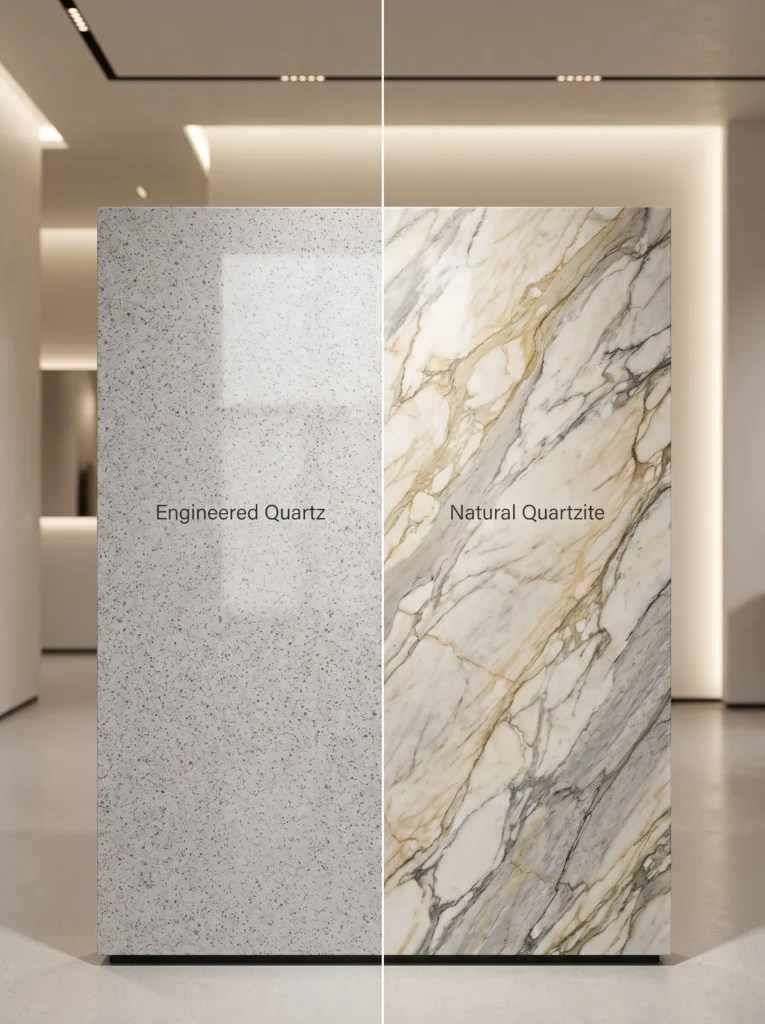
Although their names sound almost identical, quartz and quartzite are very different materials.
Quartz countertops are engineered surfaces made by combining natural quartz crystals with resins and pigments. This creates a consistent appearance, excellent durability, and a surface that requires very little ongoing maintenance.
Quartzite countertops, on the other hand, are cut from natural stone. Every slab is unique, with its own veining, colour variation, and character formed over thousands of years beneath the earth’s surface.
Neither option is automatically better.
The better choice depends on what you value most in your kitchen.

If Easy Maintenance Is Your Priority, Quartz Usually Wins
For many homeowners, the kitchen is one of the busiest rooms in the house.
Breakfast before work.
Homework around the island.
Weekend baking.
Family dinners.
In a kitchen that’s constantly in use, low maintenance can become one of the most valuable features a countertop offers.
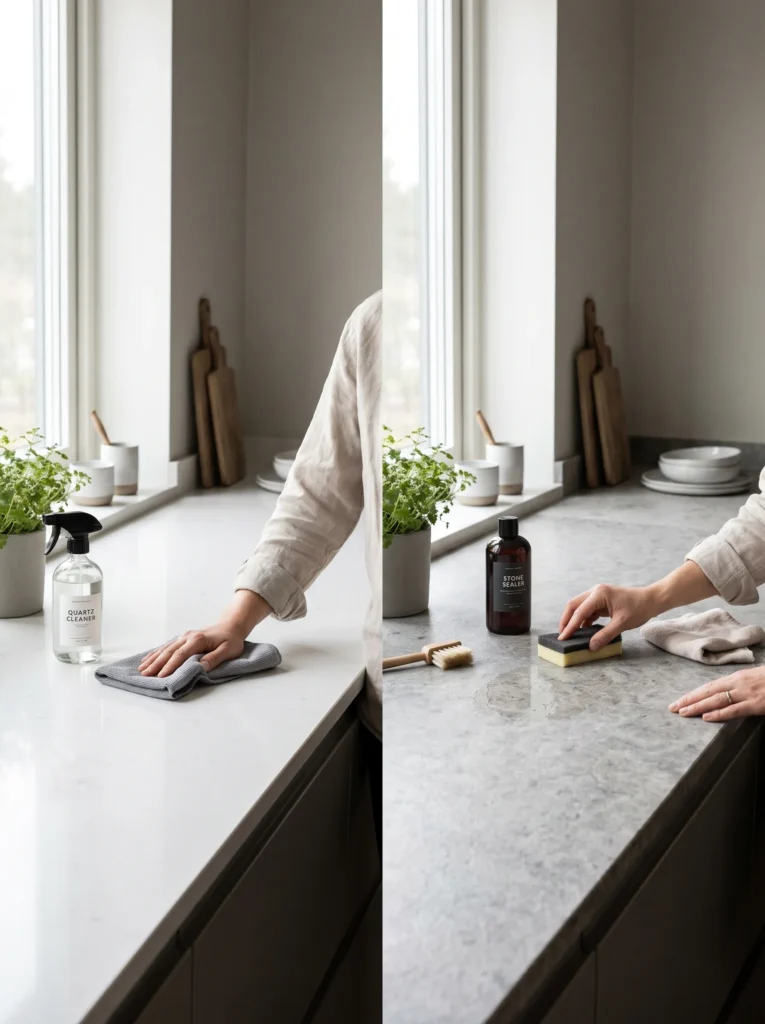
Quartz doesn’t require regular sealing because its engineered surface is non-porous.
That means everyday spills from coffee, juice, cooking oil, or tomato sauce are generally easier to clean before they become a problem.
Routine care usually involves nothing more than a soft cloth, warm water, and a gentle cleaner.
If your goal is to spend less time maintaining your countertops and more time enjoying your kitchen, quartz is often the more practical choice.

If You Love the Character of Natural Stone, Quartzite Stands Out
Some materials have a sense of individuality that manufactured surfaces simply can’t replicate.
Quartzite is one of them.
Every slab features unique veining, subtle colour changes, and natural movement that give the kitchen a distinctive appearance.
No two installations are exactly alike.
For homeowners who appreciate organic materials and want their kitchen to feel timeless rather than perfectly uniform, quartzite offers a level of authenticity that’s difficult to imitate.
That beauty does come with a little extra responsibility.
Because quartzite is natural stone, it generally benefits from periodic sealing to help protect the surface from stains and moisture.
Many homeowners consider that small amount of maintenance well worth it for the natural character they receive in return.
Busy Family Kitchen? Think About Everyday Life, Not Just Appearance
Imagine your kitchen on a typical weekday.
Children preparing snacks.
Someone placing a hot pan beside the stove.
Coffee cups sitting on the island.
Groceries being unpacked.
This is where your choice becomes less about design and more about lifestyle.
Quartz performs exceptionally well in active households because it’s easy to clean and resistant to many everyday stains.
Quartzite, while incredibly durable, asks for a little more attention over the years to keep it looking its best.
If your kitchen is constantly busy and convenience matters, quartz often provides greater peace of mind.
If you’re creating a dream kitchen where natural beauty is your highest priority, quartzite may still be worth the additional care.
Heat Resistance: Here’s Where Quartzite Has the Advantage
Heat is one area where these materials begin to separate more clearly.
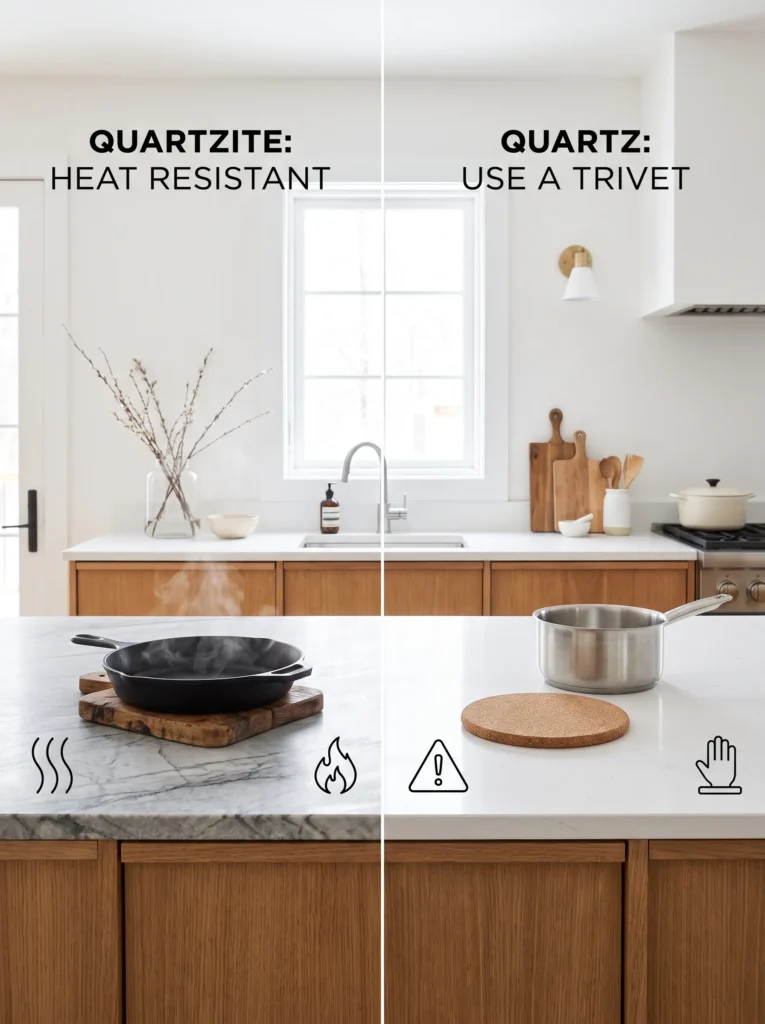
Quartzite, being a natural stone, handles high temperatures extremely well.
While it’s still wise to use trivets or hot pads to protect any countertop, quartzite is generally more forgiving when exposed to heat.
Quartz is also durable, but because it contains resins, prolonged exposure to very hot cookware may increase the risk of surface damage over time.
For most households, this isn’t a daily concern.
However, if you cook frequently and often move hot pots directly from the stove, quartzite provides an extra margin of confidence.

Appearance: Consistency or Natural Variation?
When comparing quartz and quartzite, there’s no universally better appearance.
It depends entirely on the style of kitchen you’re trying to create.
Quartz offers consistency.
Patterns remain predictable from slab to slab, making it easier to match large islands, backsplashes, and additional countertop sections.
Quartzite celebrates variation.
Its natural veining and subtle colour differences create a one-of-a-kind surface that becomes a focal point rather than simply another design element.
If you prefer a clean, contemporary kitchen with controlled patterns, quartz is often the better fit.
If you appreciate the unique beauty that only natural stone can provide, quartzite offers something engineered materials cannot fully reproduce.
Durability: Both Are Built to Last
When homeowners compare countertops, durability is usually near the top of the list.
The good news is that both quartz and quartzite are designed to handle years of everyday use.
Quartz is highly resistant to scratches, chips, and common household stains, making it a dependable choice for busy kitchens.
Quartzite is equally impressive. As a natural stone, it’s exceptionally hard and stands up well to everyday wear when properly cared for.
Rather than asking which material is stronger, it’s more useful to ask which type of durability matters most to you.
If you want a surface that’s easy to maintain while standing up to daily family life, quartz is an excellent choice.
If you prefer the strength and character of natural stone and don’t mind occasional maintenance, quartzite delivers outstanding long-term performance.
Which Countertop Is Easier to Maintain?
Maintenance is often the deciding factor once the excitement of choosing colours and finishes has passed.
Quartz
Quartz requires very little ongoing care.
Because it’s non-porous, routine cleaning is usually all that’s needed.
There is no regular sealing schedule, making it one of the easiest countertop materials to own.
Quartzite
Quartzite needs a little more attention.
Most quartzite countertops benefit from periodic sealing to help protect the stone from moisture and staining.
Cleaning is still straightforward, but long-term maintenance becomes part of owning a natural stone surface.
Neither option is difficult to care for.
The difference is simply how much maintenance you’re comfortable adding to your routine.
Which One Offers Better Value?
Price matters, but value goes beyond the number on the quotation.
Quartz often provides excellent overall value because installation is predictable, maintenance costs are lower, and the material performs consistently for many households.
Quartzite can sometimes cost more depending on the stone itself, fabrication, and installation.
However, buyers aren’t simply paying for a countertop.
They’re investing in a unique piece of natural stone that cannot be perfectly replicated.
Think about value in terms of your priorities.
If convenience and long-term simplicity matter most, quartz often represents the better investment.
If owning genuine natural stone is part of your vision for your home, quartzite may justify the additional cost.
Which Countertop Fits Your Lifestyle?
Instead of comparing technical specifications, think about how your kitchen is used every day.
Choose Quartz If…
- You want the lowest-maintenance option.
- Your kitchen sees heavy daily use.
- You have young children or a busy family.
- You prefer consistent colours and patterns.
- Easy cleaning is one of your top priorities.
Choose Quartzite If…
- You love authentic natural stone.
- Unique veining matters more than perfect consistency.
- You’re comfortable sealing the surface when needed.
- You enjoy timeless, organic materials.
- You want every countertop to be one of a kind.

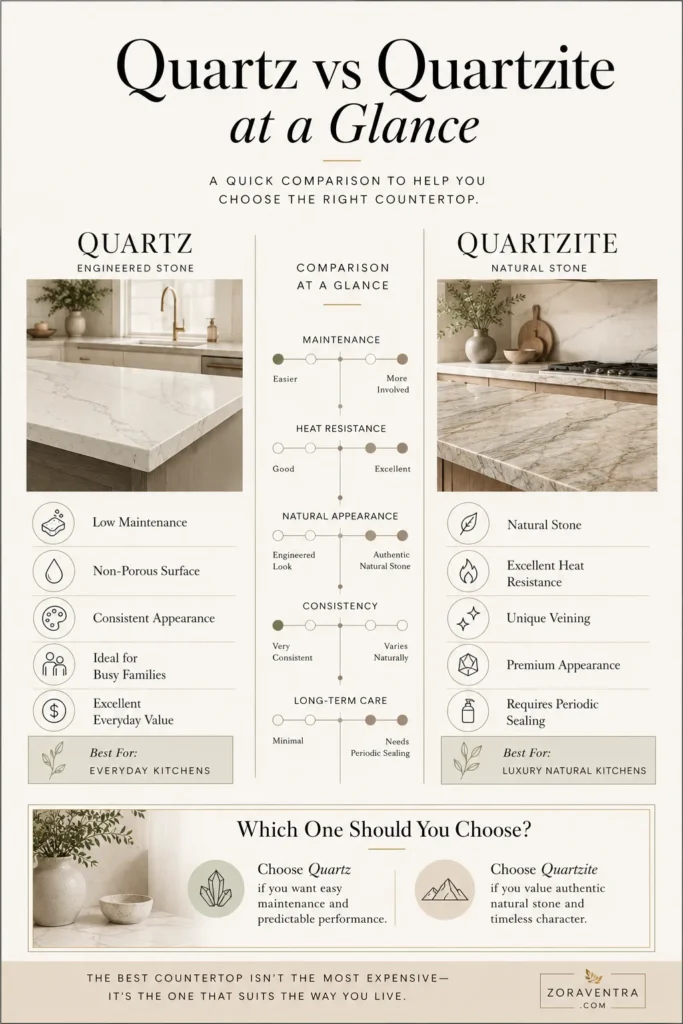
Quartz vs Quartzite at a Glance
| Feature | Quartz | Quartzite |
|---|---|---|
| Material | Engineered stone | Natural stone |
| Appearance | Consistent patterns | Unique natural veining |
| Maintenance | Very low | Moderate |
| Sealing Required | No | Yes |
| Heat Resistance | Very Good | Excellent |
| Stain Resistance | Excellent | Excellent (when sealed) |
| Best For | Busy family kitchens | Homeowners who love natural stone |
This comparison isn’t about declaring a winner.
It’s about understanding which material aligns more closely with your home and your daily routine.
Still undecided?
If you’ve been weighing the pros and cons of both materials, the comparison below brings together the most important differences at a glance. It’s a quick way to review everything you’ve learned before making your final decision

Questions Worth Asking Before You Decide
Before visiting a showroom or requesting samples, ask yourself a few practical questions.
- Do I want the convenience of a low-maintenance countertop, or am I happy to care for natural stone?
- Is my kitchen primarily a busy family workspace or a space where design takes centre stage?
- Do I prefer perfectly consistent patterns or the uniqueness of natural veining?
- How important is long-term maintenance in my decision?
- Which material better reflects how I’ll use my kitchen over the next ten years?
Answering these questions often makes the decision much clearer than comparing technical specifications alone.
Common Mistakes When Comparing Quartz and Quartzite
Choosing between these two materials isn’t usually difficult once you focus on how your kitchen will actually be used. However, a few common mistakes can lead homeowners toward the wrong decision.
Choosing Based Only on Appearance
It’s easy to fall in love with a beautiful slab in a showroom.
But countertops aren’t simply decorative features—they’re work surfaces you’ll use every day.
A material that perfectly suits your lifestyle will usually bring more satisfaction than one chosen for appearance alone.
Underestimating Maintenance
Some homeowners assume all stone countertops require the same level of care.
They don’t.
Quartz is designed for minimal maintenance, while quartzite benefits from occasional sealing to help preserve its natural beauty.
Understanding that difference before buying prevents surprises later.
Focusing Only on Initial Cost
The cheapest quote isn’t always the best value.
Think about ownership over the next ten or fifteen years.
Cleaning.
Maintenance.
Durability.
Daily convenience.
Sometimes spending a little more upfront leads to greater satisfaction over the long term.
Ignoring Your Kitchen Habits
Ask yourself one simple question:
How do I actually use my kitchen?
Someone who cooks every evening has different priorities from someone who mainly entertains on weekends.
Your countertop should support your lifestyle—not someone else’s
Which Countertop Fits Your Home?
There’s no universal winner in the quartz versus quartzite debate.
Instead, think about which description sounds more like your home.
Quartz is probably the better choice if you:
- Prefer low-maintenance living.
- Cook frequently and need easy cleanup.
- Like consistent colours and patterns.
- Want a durable surface with minimal upkeep.
- Value practicality as much as appearance.
Quartzite is probably the better choice if you:
- Love the uniqueness of natural stone.
- Want every slab to have its own character.
- Don’t mind occasional sealing.
- Appreciate organic veining and texture.
- See your countertops as a long-term design feature.

Choosing With Confidence
By now, you’ve probably realised that this decision isn’t really about finding the “better” countertop.
It’s about finding the one that complements the way you live.
A busy family kitchen may benefit from the simplicity and consistency of quartz.
A homeowner who values natural materials and timeless character may never regret choosing quartzite.
Both can create beautiful kitchens.
Your countertop choice also affects how your cabinetry looks. If you’re planning a kitchen renovation, read our guide on Are White Kitchen Cabinets Still in Style? to see how countertop materials and cabinet finishes work together.
Both can last for many years.
The difference lies in the experience of living with them every day.
When your countertop reflects both your design style and your daily routine, it becomes more than a surface—it becomes part of a kitchen that truly works for your home.
Frequently Asked Questions
Is quartz more durable than quartzite?
Both materials are highly durable for everyday kitchens. Quartz is exceptionally resistant to stains and requires very little maintenance, while quartzite is extremely hard and naturally heat resistant. The better choice depends more on your lifestyle than on durability alone.
Does quartzite need sealing?
Yes. Most quartzite countertops benefit from periodic sealing to help protect the natural stone from moisture and staining. The exact schedule depends on the type of stone and how heavily the countertop is used.
Which countertop is better for busy families?
Quartz is often the preferred choice for busy households because it’s non-porous, easy to clean, and doesn’t require regular sealing.
Can quartz look like natural stone?
Yes. Many quartz designs are inspired by marble and quartzite, offering realistic veining with a more consistent appearance from slab to slab.
Is quartzite worth the extra maintenance?
For homeowners who love the character of genuine natural stone, many believe the unique veining and timeless appearance make the occasional maintenance worthwhile.