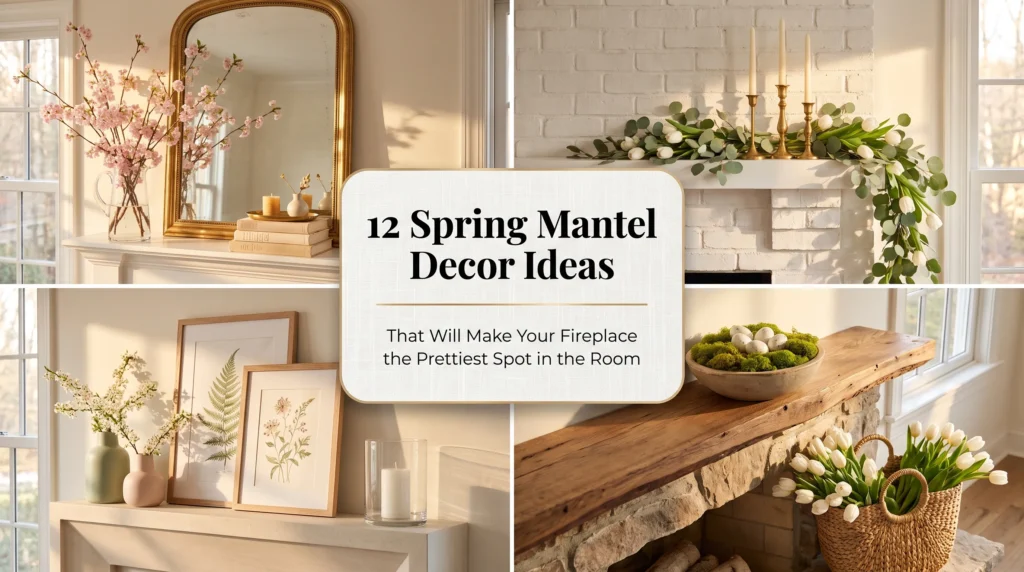
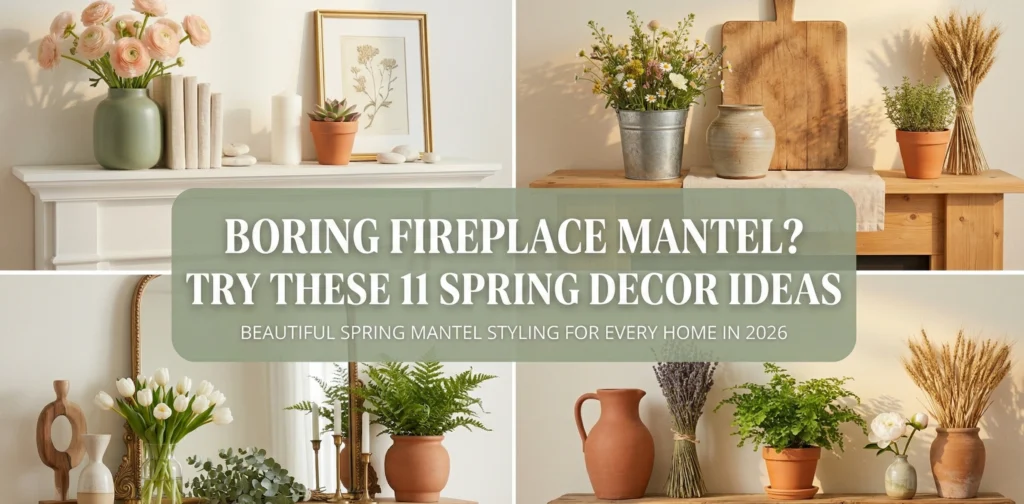
Spring has a way of making you want to refresh everything in sight — including your fireplace mantel. The good news is that you don’t need a big budget or a designer’s eye to make it beautiful. With a clear colour palette and a few thoughtful seasonal swaps, your mantel can become the prettiest focal point in your living room. For even more seasonal inspiration, browse these spring mantel decor ideas, or see how a white brick mantel makes the perfect backdrop for spring styling.
Every idea below follows the same simple formula: pick two or three colours first, then build around them. Most of these looks cost next to nothing if you shop your own home first — and a farmhouse-style mantel built on natural materials can carry you from spring into summer with just a couple of small swaps.
1. Start With a Colour Story
Before you move a single object, decide on your spring palette. Two or three colours chosen deliberately make every decision that follows feel effortless: sage green with warm cream and soft white, blush pink with natural linen and wood tones, or butter yellow with terracotta and clean white.
Colour consistency is what separates a mantel that looks designed from one that looks randomly assembled. When everything belongs to the same colour family, the whole display looks intentional — whether your fireplace is modern, farmhouse, rustic or traditional.

2. Lean Art Against the Mantel
A leaning print is the single most impactful budget styling move you can make. It creates a visual backdrop that makes everything in front of it look more composed, and leaning rather than mounting feels relaxed and current.
On white brick, a large botanical watercolour or simple line-drawn floral in a thin brass or wood frame looks stunning — the organic texture of the brick against the softness of the print is genuinely striking. You don’t need to buy new art: a printable botanical illustration costs almost nothing. Layer a smaller print in front of the larger one at a slightly different angle for extra depth.

3. Pair Greenery With One Hero Floral
Greenery and florals are the foundation of every great spring mantel — the trick is in the pairing. Keep it simple and deliberate: a stem of eucalyptus laid along the mantel edge beside a small vase of blush ranunculus, trailing ivy in a terracotta pot next to a single white tulip in a bud vase, or dried pampas beside fresh cream sweet peas.
Treat the greenery as the supporting act and let one floral be the star, placed slightly off-centre rather than dead centre. Mixing one fresh variety with one dried variety adds a collected, seasonal quality that needs no professional skill.

4. Style It With Just Five Objects
The simplest mantels are the most sophisticated. Try one strict rule: a maximum of five objects on the mantel at a time — one tall piece, one medium, one low, one living or botanical element, and one personal object. Everything else stays off.
Limiting yourself forces each piece to earn its place, and the breathing room makes every object look important. Uncluttered mantels are also the most saved on Pinterest every season — and they’re simply more pleasant to live with day to day.

5. Build a Farmhouse Look From Natural Materials
The farmhouse spring mantel is warm, genuine and built on honest imperfection: a worn wooden board leaning at the back, a galvanized bucket of wildflowers, a clay pot of growing herbs, dried botanicals tied with jute twine, hand-thrown pottery in an earthy glaze, and a linen runner along the shelf.
Let things be slightly imperfect — a weathered edge, visible texture on the clay, stems leaning at natural angles. That is what makes rustic styling feel real and lived-in. A small chalkboard sign or a gingham ribbon around a lavender bundle adds instant farmhouse warmth for almost nothing.

6. Cluster Candles at Different Heights
Candles are one of the most powerful budget styling tools you own. A cluster at varied heights creates warmth, movement and depth all at once — and shifts the mantel from purely decorative to genuinely atmospheric.
Try three pillars at different heights grouped as one element, five slim tapers in brass holders, or one large church candle surrounded by spring botanicals. Keep the candles in your palette — cream, blush, sage, warm white — and mix lit and unlit candles for a lived-in feel.

7. Try the Modern Farmhouse Balance
Modern farmhouse is the most saved mantel aesthetic on Pinterest right now: farmhouse warmth meets clean contemporary lines. The formula is simple — pair one warm organic element with one clean contemporary one: natural wood beside white ceramic, woven texture beside smooth glass, raw terracotta beside polished brass.
Keep the palette tightly edited — warm whites, creams, sage and muted blush — and the same formula carries you into summer with just a floral swap or two, so your effort stretches across seasons.

8. Dress the Wall Above the Mantel Too
The wall above your mantel is one of the most powerful styling surfaces in your home — yet most people treat it as separate from the shelf. Style them as one composition: the wall anchors the mantel, and the mantel grounds the wall.
On a budget, the biggest wins are a large botanical print (or three matching frames as a gallery wall), a dried eucalyptus or lavender wreath hung with a single nail, or a round mirror that reflects your display and the room’s spring light.

9. Go All White for the Most Elegant Refresh
An all-white spring mantel sounds monotonous in theory, but in practice it’s the opposite: with no colour to look at, your eye notices texture, shape and height instead. A tall cylindrical vase beside a squat bowl, a smooth marble egg beside a rough pot, matte beside glossy — each contrast creates the interest that colour normally provides.
It photographs beautifully, suits every light, and costs nothing in seasonal colour — one of the most budget-friendly approaches there is.

10. Use Dried Botanicals for Lasting Texture
Dried botanicals are the most underrated budget material for spring: pampas grass, lavender tied with twine, wheat stalks, dried eucalyptus, citrus slices wired onto a branch. They cost very little, last the whole season with zero maintenance, and feel handcrafted and personal.
Mix them with at least one fresh or living element — dried lavender beside one fresh white peony, pampas beside a small fern in terracotta — for a layered, collected look that never looks like a purchased set.

11. Layer Front to Back for Real Depth
The difference between a nice mantel and an inspiring one is layering — and that means depth, not just height. Place some pieces at the back against the wall, a medium grouping of vases and botanicals in the middle, and low finishing touches — a stone, a small dish, a tiny pot — at the front edge.
Then let one trailing botanical — an ivy vine, a pothos tendril, a eucalyptus branch — fall naturally over the front edge. That single organic touch is the most spring-like thing you can add.

Five Golden Rules for Every Spring Mantel
Palette before placement. Choose two or three spring colours before touching a single object — anything that fails the palette test stays off the mantel.
Lean before you mount. A leaning print looks more current and relaxed than a mounted one, and costs nothing to change next season.
Vary height and depth together. Tall, medium and low objects across the front, middle and back of the shelf.
Leave genuine breathing room. Keep at least a quarter of the surface empty — empty space is part of the design.
Add one trailing botanical. A vine over the edge makes any spring mantel feel organic and alive.
Quick Answers
How can I decorate my spring mantel on a tight budget?
Shop your own home first: rearrange vases, books and candle holders you already own, cut greenery from your yard, and print botanical art at home. Thrift stores and dollar stores are goldmines for vases, frames and candle holders — a coat of cream spray paint makes mismatched finds look cohesive.
What colours work best for a spring mantel?
Stick to two or three: sage green with warm cream and soft white, blush pink with natural linen and wood tones, or butter yellow with terracotta and clean white. A limited palette is the fastest way to make a budget display look designer-made.
How many items should go on a mantel?
Five is the sweet spot: one tall piece, one medium, one low, one botanical element and one personal object. Fewer, well-chosen pieces always look more expensive than a crowded shelf.
How do I style a plain or small mantel so it still looks good?
Lean one large piece of art against the wall to create a backdrop, vary your heights, and add a single trailing plant over the edge. An all-white arrangement also makes a small mantel feel calm and elegant rather than sparse.
Final Thoughts
Your mantel is the focal point of your living room — every guest notices it first. Making it feel beautiful for spring, without overspending, is one of the most rewarding small projects of the season.
Start with your palette. Lean your art. Build your layers. Add greenery. Trail something over the edge. Then step back from across the room — if it makes you stop and smile, it’s perfect exactly as it is.